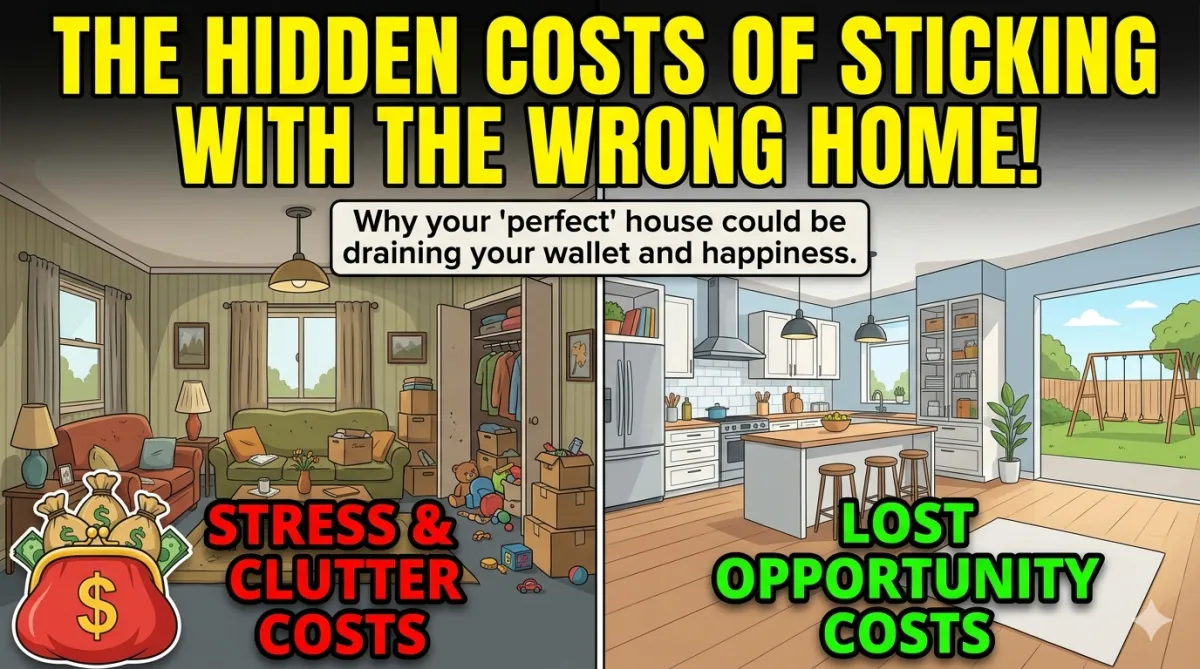
The Hidden Costs of Staying in a Home That No Longer Fits Your Family
The Hidden Costs of Staying in a Home That No Longer Fits Your Family
It doesn’t start with a big problem 1
The financial cost people don’t think about 2
Space problems turn into daily friction 3
The emotional cost nobody budgets for 4
The “we’ll fix it later” trap 5
When selling starts to feel complicated 6
The showing phase is where reality hits 7
Moving fast without leaving money behind 8
When staying starts costing more than moving 9
The lifestyle gap gets wider over time 10
There’s a moment a lot of homeowners hit, but they don’t always say it out loud.
The house still works… technically.
But it doesn’t feel right anymore.
Maybe the kids got bigger. Maybe everyone’s working from home now. Maybe the space just feels tighter, louder, more cluttered than it used to. Nothing is broken, but it’s not comfortable either.
And so people stay. Because moving feels like a lot. Because the market feels uncertain. Because life is busy enough already.
But staying in a home that no longer fits has its own cost. And most of it doesn’t show up on a spreadsheet.
It shows up in how your days feel.
It doesn’t start with a big problem
Most families don’t wake up one day and decide their home no longer works.
It builds slowly.
A spare bedroom becomes an office. Then a storage room. Then a “we’ll deal with it later” room.
Kids start sharing space that used to feel big. The kitchen starts feeling crowded during normal routines. The living room becomes multi-purpose in a way that never really feels organized.
And at first, you adjust. That’s what people do.
But over time, adjusting becomes the default. And you stop noticing how much you’re working around your own house just to make it function.
That’s usually the first sign something has shifted.
Not a dramatic one. Just a quiet one.
The financial cost people don’t think about
There’s an obvious financial layer to staying put, but it’s not always the one people expect.
It’s not just about mortgage rates or equity or timing the market.
It’s about how efficiently your money is actually working for you inside the home you already have.
Bigger homes cost more to heat and cool. Rooms that don’t get used still cost money to maintain. Extra square footage that doesn’t match your lifestyle becomes something you pay for without really benefiting from it.
Then there’s the equity question. A lot of homeowners assume staying put is always the safest financial move. But depending on the situation, it can also mean missing opportunities to reposition that equity into something that actually fits your life better right now.
And sometimes there are more complicated financial layers underneath the surface, especially when older loans or past refinancing decisions are still connected to the property. A lot of homeowners don’t even think about it until they start preparing to move again, but situations like that can surface in ways that catch people off guard and end up affecting the timing or outcome of the sale.
It’s not about panic. It’s about clarity before you make your next move.
Because staying put isn’t always neutral. It has carrying costs too.
Space problems turn into daily friction
This is the part most people feel before they can name it.
It’s not that your home is “too small.” It’s that it doesn’t match how you live anymore.
One person needs quiet. Another needs space for work calls. Someone else just wants a place to put their things without it spilling into shared areas.
And suddenly the house becomes a rotation system instead of a flow.
People take turns using space instead of sharing it comfortably.
That shift creates friction. Not big arguments. Just constant small adjustments that wear on people over time.
You notice it in how often you’re rearranging things. How often you’re cleaning just to keep up. How often rooms feel like they reset themselves overnight in the wrong way.
It’s subtle, but it adds up.
The emotional cost nobody budgets for
This is the one people usually underestimate the most.
A home that doesn’t fit anymore doesn’t just affect space. It affects energy.
You feel it in small ways first. Less patience. More clutter stress. That feeling of always being slightly behind on your own environment.
Then it becomes background noise.
It’s easy to ignore this part because it doesn’t feel urgent. But it affects daily life more than most financial decisions do.
A home shapes how you move through your day. When it stops fitting, everything takes a little more effort.
The “we’ll fix it later” trap
A lot of families stay longer than they should because they convince themselves they’ll renovate later.
Or the kids will eventually move out. Or work will change. Or life will slow down.
And sometimes that’s true.
But often, life doesn’t slow down. It just shifts into a different version of busy.
So the house stays in limbo. Not quite updated. Not quite right. Always halfway between what it was and what it could be.
That middle space is where people tend to stay the longest.
And the longer you stay there, the harder it gets to see the situation clearly.
When selling starts to feel complicated
At some point, most homeowners start thinking about selling. Even if it’s just quietly in the back of their mind.
But then the questions show up.
Is it worth it?
Will we lose money?
Is it the right timing?
And that’s where people often get stuck.
Because selling isn’t just about listing a home. It’s about positioning it correctly in a market that reacts quickly to pricing, presentation, and demand.
Pricing is one of those areas where small mistakes can end up costing more than people expect, especially when homes sit longer than they should or start attracting the wrong kind of attention, which is why it’s worth paying attention to the common pricing missteps that sellers tend to run into in the Southeast Valley.
Because pricing isn’t just a number. It sets the tone for everything that follows.
The showing phase is where reality hits
A lot of homeowners don’t think about how their home feels to someone walking through it for the first time.
They’re used to it. So they don’t see it the same way.
But buyers do.
They notice the flow of rooms. How cluttered or open a space feels. Whether it’s easy to imagine living there or if everything feels like it needs adjustment before it works.
And this is where small details matter more than people think.
A home that shows well doesn’t have to be perfect. But it does need to feel intentional. It needs to feel like someone cared about how it presents.
That’s often where sellers get surprised. They assume the home will “speak for itself,” but presentation can really shift how a buyer connects with it in the moment. That’s why getting the home ready before showings matters more than people think, especially when expectations are high and every detail counts.
Because once a buyer walks out the door, you don’t get that moment back.
Moving fast without leaving money behind
Another hesitation homeowners have is speed.
They don’t want the process to drag out. They also don’t want to rush and lose value.
That tension is real.
And the truth is, homes that are priced right, prepared well, and positioned correctly tend to move differently than homes that are just listed and hoped for the best.
But there’s a balance. Moving quickly doesn’t mean cutting corners. And waiting longer doesn’t always mean better results.
It comes down to how the home is presented and how the strategy is built from the start.
There are ways to sell efficiently without leaving value on the table, but it comes down to being intentional with each step, from pricing to presentation to timing. That’s why many homeowners take time to understand what a smooth, well-planned sale actually looks like before they make any decisions.
Because speed and value don’t have to compete. But they do need to be balanced carefully.
When staying starts costing more than moving
There’s a point where staying feels easier, but it isn’t actually simpler.
You’re just used to it.
The routines are familiar. The mortgage is predictable. The idea of change feels heavier than the discomfort you’ve already adapted to.
But that doesn’t mean the situation is improving.
It just means you’ve adjusted to it.
And that’s where a lot of homeowners stay longer than they planned.
Not because the home still fits.
But because change feels like more work than staying put.
The lifestyle gap gets wider over time
One of the biggest things people miss is how quickly lifestyle needs shift.
A home that worked five years ago might not support how you live today. And five years from now, that gap can feel even wider.
Remote work changes things. Kids change things. Daily routines change things.
Even small shifts in how you use your space can slowly reshape what you actually need from a home.
And when your home stops matching that, life starts feeling slightly out of sync.
Not in a dramatic way. Just enough to notice.
So what do you do with that feeling?
Most people already know when their home doesn’t fit anymore.
They just don’t act on it right away.
And that’s normal. Big decisions take time to process. Especially when they involve your home.
But ignoring the feeling doesn’t make it go away. It just pushes it further into the background while life keeps moving forward.
At some point, it helps to look at the situation honestly. Not just financially, but practically. Does your home support your current life? Or are you constantly adjusting your life to support your home?
That question alone tends to bring clarity.
Final thoughts
A home that no longer fits doesn’t always feel wrong. It just feels slightly off. And that “off” feeling can last a long time before it turns into action.
But the hidden cost is real.
It shows up in your space. Your routines. Your energy. Your patience. Even your decisions.
And once you start noticing it, it’s hard to unsee.
The good news is you don’t have to rush anything. But you also don’t have to ignore it either.
Because the goal isn’t just owning a home.
It’s living in one that actually supports your life as it is right now.
About the Author
Nancy Wittenberg is a real estate agent based in Ahwatukee, Arizona with Coldwell Banker Realty. She works with buyers and sellers throughout the Southeast Valley, including Chandler, Mesa, Tempe, and surrounding communities, helping people make confident real estate decisions without the overwhelm.
Her focus is simple. Help people understand what actually makes sense for their situation, not just what looks good on paper. That includes lifestyle, timing, and how each home fits into day-to-day life.
Nancy is also the creator of the Buyer Care Plan™, a step-by-step process designed to help clients move through buying or selling with clarity and direction at every stage.