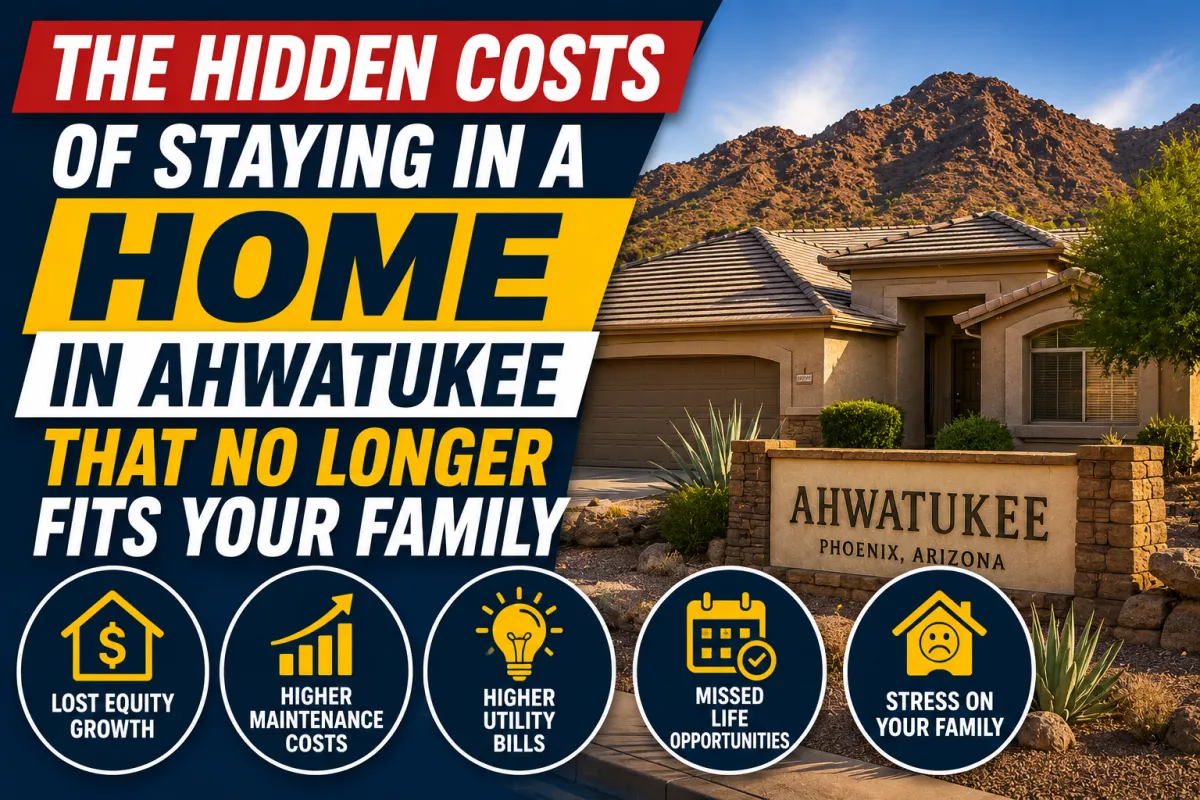
The Hidden Costs of Staying in a Home in Ahwatukee That No Longer Fits Your Family
The Hidden Costs of Staying in a Home in Ahwatukee That No Longer Fits Your Family
When a home starts feeling too small, too big, or just off 1
The financial leaks that don’t feel like leaks 2
Space you pay for but don’t really use 3
The emotional cost that builds slowly 4
Life changes faster than houses do 5
The lifestyle shift you don’t notice until it’s already happened 6
When staying starts limiting your options 7
There are times when staying still actually makes sense 8
When moving starts to make more sense than adjusting again 9
The real decision is about how your life feels inside the walls you already own 10
A lot of people don’t realize they’re paying for their house twice.
Once on the mortgage. And again in all the ways it quietly stops fitting their life.
That second part is the one nobody talks about enough, especially in a place like Ahwatukee where people tend to stay longer than they planned. The neighborhood feels stable, the schools are solid, the mountain views make everyday life feel a little calmer, and before you know it, years pass while your family changes in ways your home never really adjusted to.
This isn’t really about whether your house is “bad” or “good.” It’s about fit. And when a home stops fitting, the cost shows up in places you don’t always connect at first.
Let’s talk through what that actually looks like.
When a home starts feeling too small, too big, or just off
It usually doesn’t happen all at once.
At first, it’s small stuff. A hallway that feels tighter than it used to. A kitchen that feels crowded when everyone is home at once. A backyard that doesn’t get used anymore because everyone is doing different things now.
Then it builds.
Maybe your kids are older and need more privacy. Maybe you’re working from home more often and there’s nowhere quiet to think. Or maybe the house is just bigger than your life needs now, and you’re maintaining rooms you barely step into except to dust them.
In Ahwatukee, this is common because a lot of homes were built in earlier decades when families used space differently. What worked in the 90s doesn’t always match how people live today.
If you’ve ever caught yourself rearranging furniture again just to “make it work,” that’s usually a sign something deeper is going on.
And it’s not just about comfort. It starts affecting decisions, energy, and money in ways that are easy to overlook.
The financial leaks that don’t feel like leaks
People think staying put saves money. Sometimes it does. But there’s another side to it.
A home that no longer fits often creates slow financial drag that doesn’t show up as one big expense, but shows up in pieces.
You might be spending more on heating and cooling rooms you barely use. Or paying for extra square footage that doesn’t add value to your daily life. Maybe you’ve started doing small upgrades just to make the space feel better, but those upgrades keep stacking without really solving the core issue.
Then there’s maintenance. Older homes in Ahwatukee often come with ongoing upkeep that feels normal at first, until you realize you’re constantly budgeting for something. Roof repairs, plumbing fixes, flooring updates, yard work that takes more time than you want to give.
None of this is shocking on its own. It only becomes obvious when you step back and see the pattern.
This is where it helps to zoom out a bit and look at the full picture of what owning a home in Ahwatukee actually costs, because most people lock in on the purchase price and forget how ongoing expenses change over time depending on how well the home fits their life.
Space you pay for but don’t really use
Unused space is one of the biggest hidden costs.
A guest room that hasn’t had a guest in years. A formal dining area that turned into storage. A bonus room that became a place to drop things “for later.”
You’re still paying for all of it through your mortgage, insurance, taxes, and maintenance. It’s just spread out so it doesn’t feel obvious.
In Ahwatukee, where many homes sit on larger lots or have older layouts with defined rooms, this happens more than people expect. Homes were designed for a different rhythm of living, more separation between spaces, more formal use of rooms, less flexibility.
Now life is more blended. Work happens at home. Kids need study space. Everyone wants a place to decompress.
When the layout doesn’t match that, the house starts to feel slightly out of sync with your day-to-day routine, even if everything is technically fine.
The emotional cost that builds slowly
This is the part people usually recognize last.
A home that doesn’t fit doesn’t just affect your schedule or your budget. It affects how you feel in it.
You might notice it when you avoid certain rooms. Or when weekends feel more like catching up on house maintenance than actually resting. Or when you’re constantly thinking about what you would change “if you ever got around to it.”
That mental load adds up.
It’s subtle, but it changes how you experience your own space. Instead of feeling like your home supports you, it starts to feel like something you’re managing.
That shift is hard to measure, but very real.
If you’re wondering whether that feeling is normal or a sign you’re ready for something different, it can help to step back and look at the bigger lifestyle picture in Ahwatukee. Even if moving isn’t on your mind, it gives you a clearer sense of how different housing choices shape everyday life in the area.
Life changes faster than houses do
One of the biggest reasons this issue shows up in Ahwatukee is time.
People buy homes during one stage of life. Then life moves forward. Careers shift. Kids grow. Work becomes more remote. Priorities change.
The house stays the same.
And that’s the tension.
A layout that made perfect sense when your kids were small can feel completely mismatched later. A commute that used to feel fine might feel draining now. A neighborhood you chose for schools might not be the main reason you stay anymore.
This is where a lot of people start thinking about timing, especially in relation to the market. Not because they’re trying to time everything perfectly, but because they’re trying to figure out whether staying or moving makes more sense right now.
That’s where it helps to look at whether now even makes sense for a move in Ahwatukee, not as a prediction tool, but as a way to understand how current market condition of purchasing a home could shape your options if you decide to make a change.
The lifestyle shift you don’t notice until it’s already happened
Ahwatukee has a very specific rhythm.
It’s quieter than central Phoenix, with mountain access that makes outdoor time easy without planning a full day around it. People move here partly for that balance. Suburban comfort, plus nature close by.
But here’s the thing. Your use of that lifestyle changes over time.
Maybe you used to hike regularly and now you don’t. Maybe you thought you’d use the nearby trails more often, but your schedule filled up differently. Or maybe your weekends now revolve around completely different priorities than when you first bought the home.
That shift matters, because it changes how valuable your location feels to you personally.
If outdoor living and nearby green space were part of why you chose the area, it might be worth getting back in touch with that side of Ahwatukee by exploring local parks and outdoor spots again. Sometimes a home feels off simply because the lifestyle around it isn’t being used the way it used to be.Other times, it highlights that the home itself is the part that no longer matches your life.
When staying starts limiting your options
This is the part people don’t always say out loud.
Staying in a home that doesn’t fit can quietly limit what else you can do.
You might delay renovations because they feel too big. Or avoid making upgrades because you’re unsure if they’re worth it. Or keep putting off decisions because moving feels complicated.
Meanwhile, your equity sits in the house, tied to something that isn’t fully serving you anymore.
That’s not just a financial question. It becomes a lifestyle one.
Could that equity be used differently? Could your monthly costs shift in a way that frees up room for other priorities? Could your time feel different in a space designed for how you actually live now?
These are the questions that tend to surface once the mismatch becomes hard to ignore.
There are times when staying still actually makes sense
Not every mismatch means you should move.
Sometimes the house is still solid, and the issues are more about temporary life stages than long-term fit. Maybe you’re in a transition year. Maybe you’re planning for something specific that will change how you use space soon. Maybe the financial timing really doesn’t line up yet.
There’s also the reality that moving comes with its own set of costs, stress, and decisions. It’s not always lighter. Sometimes it’s just different.
This is where it helps to be honest about what’s actually bothering you. If it’s fixable with small changes, that’s one thing. If it’s structural, meaning layout, location, or long-term lifestyle mismatch, that’s something else entirely.
Most people already know which one it is. They just don’t always say it clearly.
When moving starts to make more sense than adjusting again
There’s a point where “making it work” becomes a pattern instead of a solution.
You start adjusting rooms instead of solving the core issue. You keep telling yourself the next small change will fix it. You start avoiding parts of your own home because they don’t function the way you need them to anymore.
That’s usually the moment the hidden cost becomes real.
Not dramatic. Just consistent.
And over time, consistency is what wears people down.
At that stage, moving isn’t about chasing something better. It’s about getting back to a normal level of ease in your own space.
The real decision is about how your life feels inside the walls you already own
This isn’t really a conversation about real estate. It’s a conversation about how much friction you’re willing to live with every day.
Some homes carry you through different stages of life without needing much adjustment. Others served you well once, but now require constant work just to keep up.
Neither is a failure.
But they do lead to different outcomes over time.
The quiet part most people realize eventually is that staying in a home that doesn’t fit doesn’t feel neutral. It slowly shapes your routines, your energy, and your choices without you noticing it right away.
And once you see that clearly, the decision becomes less about the market, and more about your day-to-day life.
If you’re sitting with that question right now, it usually helps to stop thinking about what the house is worth on paper and start thinking about what it’s costing you in real life. Time, energy, flexibility, even the way your weekends feel.
That’s the part that doesn’t show up in listings, but shows up in everything else.
Final Thought
Most people don’t wake up one day and suddenly hate their house. It’s slower than that. You just start noticing little things that don’t feel right anymore, and at first you brush them off because everything still “works.”
But homes aren’t just about working. They’re about how your days feel inside them.
If your house in Ahwatukee still supports your life, that’s a great place to be. If it doesn’t, ignoring it doesn’t usually make it better. It just stretches the gap a little wider over time.
And the sooner you get honest about that gap, the easier it is to decide what comes next.