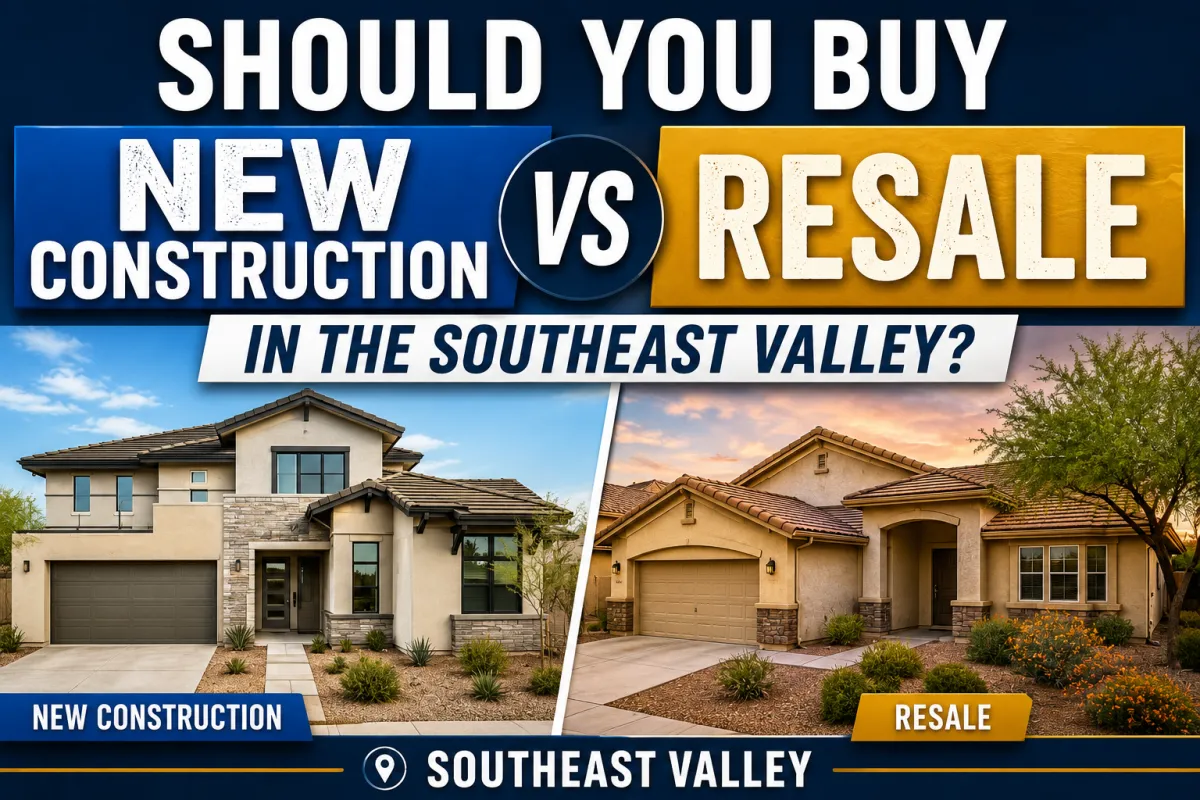
Should You Buy New Construction or Resale in the Southeast Valley?
Should You Buy New Construction or Resale in the Southeast Valley?
Start With Your Lifestyle, Not the Home 1
Why So Many Buyers Are Drawn to New Construction 2
What Living in a New Construction Community Often Feels Like 1
The Tradeoffs That Buyers Sometimes Overlook 2
Why Resale Homes Continue to Attract Buyers 3
Established Neighborhoods Have Their Own Advantages 2
The Financial Side of the Decision 4
Maintenance and Future Repairs 5
Which Option Is Better for First-Time Buyers? 6
The Emotional Side of the Decision 7
So Which One Should You Choose? 9
Buying a home in the Southeast Valley is exciting. It can also feel a little overwhelming once you realize how many choices you actually have.
One of the biggest decisions buyers face right now is whether to purchase a brand-new construction home or go with a resale property.
At first glance, the answer seems simple. New homes are shiny, modern, and move-in ready. Resale homes are established, often less expensive upfront, and located in mature neighborhoods.
But once you start touring properties throughout Chandler, Gilbert, Queen Creek, Mesa, and the surrounding Southeast Valley communities, the decision becomes much more complicated.
Because this is not really a question about new versus old.
It is a question about how you want to live, what matters most to you financially, and what kind of experience you want both during the buying process and after you move in.
The truth is that both options can be excellent choices.
The challenge is figuring out which one fits your goals better.
Start With Your Lifestyle, Not the Home
Many buyers immediately jump into comparing floor plans, upgrades, and listing photos.
That is understandable. The house itself feels like the most important part of the decision.
But focusing only on the home can sometimes lead buyers in the wrong direction.
A beautiful new construction home might have every modern feature you want, but if the location does not fit your daily routine, the excitement can wear off quickly.
On the other hand, a resale home might not have quartz countertops in every room or the latest design trends, but it could place you exactly where you want to be for work, school, restaurants, shopping, or weekend activities.
Before comparing homes, think about your life.
What does a normal Tuesday look like?
How long do you want your commute to be?
Do you want an established neighborhood with mature trees and larger lots, or are you excited about being part of a growing community where everything feels fresh and new?
Those answers often make the decision much easier.
Why So Many Buyers Are Drawn to New Construction
There is no question that new construction has strong appeal.
Walk into a model home and it is easy to understand why buyers fall in love.
Everything feels clean, bright, and thoughtfully designed. The layouts reflect how people live today. Open kitchens, larger primary suites, energy-efficient systems, and smart home technology often come standard.
For many buyers, there is comfort in knowing they are the first person to live there.
The roof is new.
The HVAC system is new.
The appliances are new.
The plumbing and electrical systems are new.
That can provide peace of mind, especially for buyers who do not want to think about repairs or maintenance right after moving in.
What Living in a New Construction Community Often Feels Like
Many Southeast Valley master-planned communities are designed around lifestyle.
You may find community pools, walking trails, parks, fitness centers, splash pads, and gathering spaces all within the neighborhood.
Everything tends to feel cohesive.
The homes match.
The landscaping is fresh.
The streets are wide and clean.
For buyers who appreciate consistency and modern design, that environment can be very attractive.
It often feels like moving into a neighborhood that has been carefully planned from the beginning.
The Tradeoffs That Buyers Sometimes Overlook
New construction is not automatically perfect.
One of the most common surprises buyers encounter is that the advertised base price is rarely the final price.
Upgrades can add up quickly.
Flooring, cabinets, countertops, appliances, landscaping, window coverings, and backyard improvements can significantly increase your overall investment.
Many buyers walk into a model home expecting one number and discover that the home they actually want costs considerably more.
That is why I always tell buyers to think in terms of monthly payment instead of just price. A home might look good on paper, but once you stack in taxes, insurance, HOA fees, and maintenance, the real cost becomes clearer.
Another consideration is timing.
Depending on the builder and community, construction can take several months. If you need to move quickly, a resale home may offer a much faster path to ownership.
Why Resale Homes Continue to Attract Buyers
Despite all the attention new construction receives, resale homes remain incredibly popular throughout the Southeast Valley.
There are several reasons for that.
Many established neighborhoods offer characteristics that simply cannot be recreated overnight.
Mature landscaping.
Larger trees.
Wider lots.
Unique architecture.
A stronger sense of neighborhood identity.
These are features that often develop over decades rather than months.
For some buyers, that character creates a feeling that newer communities cannot always match.
More Variety in Location
One major advantage of resale homes is choice.
When shopping for new construction, you are limited to where builders are actively developing.
With resale properties, your options expand dramatically.
You can choose from neighborhoods across Chandler, Gilbert, Mesa, Tempe, Ahwatukee, Queen Creek, and many other established Southeast Valley communities.
That flexibility often allows buyers to prioritize location first and then find a home that fits within that area.
For many people, that ends up being the smarter long-term move.
Established Neighborhoods Have Their Own Advantages
When you buy in an existing community, you generally know what the neighborhood looks like.
You can see the completed streets.
You can evaluate traffic patterns.
You can visit local businesses.
You can observe how residents use parks and community spaces.
There is less uncertainty.
With brand-new communities, some amenities may still be under construction. Future development plans may not be fully completed for several years.
Neither situation is necessarily better.
They are simply different experiences.
The Opportunity for Value
Resale homes can sometimes provide opportunities that new construction cannot.
A buyer may find a home with a larger lot, a pool, mature landscaping, and significant upgrades already completed.
Those improvements can represent considerable value when compared to starting from scratch in a new construction property.
That becomes especially important when evaluating overall affordability and long-term ownership costs.
The Financial Side of the Decision
Many buyers assume new construction is always more expensive.
That is not necessarily true.
There are periods when builders offer incentives, rate buydowns, closing cost assistance, or upgrade packages that make new homes surprisingly competitive.
At the same time, resale sellers may be willing to negotiate in ways that builders typically are not.
The market conditions matter.
Inventory levels matter.
Buyer demand matters.
That is why it helps buyers pay attention to how much leverage they actually have in the current market. In some situations, there are more opportunities to negotiate price, repairs, or incentives, depending on whether you are looking at new construction or resale homes.
The financial comparison should always go beyond sticker price.
Look at monthly payments.
Look at HOA costs.
Look at maintenance expectations.
Look at future repair expenses.
Look at property taxes.
When buyers compare the complete picture rather than focusing on a single number, they often make better decisions.
Maintenance and Future Repairs
This is one area where new construction usually has a clear advantage.
Most major systems are brand new.
Many components are covered by builder warranties.
Unexpected repairs are generally less likely during the first several years of ownership.
That does not mean maintenance disappears completely.
Every home requires ongoing care.
But major replacement costs are often further down the road.
With resale homes, the equation changes.
The roof may be older.
The HVAC system may have several years of use.
Water heaters, appliances, and other systems may be approaching replacement timelines.
A thorough inspection helps buyers understand these factors before closing.
For some buyers, those potential future expenses are completely acceptable.
Especially if they are getting a larger lot, better location, or more established neighborhood in return.
Which Option Is Better for First-Time Buyers?
Many first-time buyers assume they should automatically choose new construction because it feels simpler.
Sometimes that is true.
Sometimes it is not.
A resale home can actually be an excellent first purchase.
Established neighborhoods often provide more options across different price points. Buyers may also find homes that allow them to build equity through future improvements and updates.
The right answer depends less on whether the home is new or resale and more on how the numbers fit your goals.
That is why buyers often wonder about timing the market, but the real answer usually has more to do with whether the home, the monthly payment, and the overall situation actually fit their personal goals and budget.
The Emotional Side of the Decision
This part rarely gets discussed enough.
Buying a home is not purely a financial decision.
It is also emotional.
Some buyers walk into a brand-new model home and instantly know it feels right.
They love the smell of new construction.
They love choosing finishes.
They love the idea of creating something from the beginning.
Other buyers walk into an established neighborhood with mature trees, unique homes, and a sense of history and immediately feel at home.
Neither reaction is wrong.
The emotional connection matters.
You are not buying a spreadsheet.
You are buying the place where your life will happen.
The place where you will have morning coffee, celebrate holidays, host friends, and create routines.
That feeling should absolutely be part of the decision.
What About Availability?
Another factor worth considering is inventory.
Depending on market conditions, buyers may find more opportunities in one category than the other.
There are times when resale inventory becomes tight, making new construction an attractive alternative.
There are also times when resale inventory expands, creating more choices and potentially stronger negotiating opportunities.
Understanding market conditions can help buyers avoid making decisions based solely on assumptions.
This is becoming more relevant as inventory shifts, builders adjust incentives, and sellers respond to the market. There is also a growing awareness that seeing homes earlier in the process can sometimes change what options buyers even get in front of them.
So Which One Should You Choose?
Choose new construction if:
You love modern layouts.
You want minimal maintenance concerns.
You enjoy the idea of selecting finishes and personalizing your home.
You are comfortable waiting for construction if necessary.
You like the feel of newer master-planned communities.
Choose resale if:
You value established neighborhoods.
You want more location options.
You appreciate mature landscaping and larger lots.
You are looking for character and variety.
You want the ability to evaluate a fully developed neighborhood before buying.
The key is understanding that neither choice is automatically better.
The best choice is the one that aligns with your lifestyle, financial goals, and long-term plans.
Final Thoughts
The Southeast Valley offers outstanding opportunities for both new construction and resale buyers.
That is actually what makes the decision difficult.
You are not choosing between a good option and a bad option.
You are choosing between two different paths to homeownership.
One offers modern design, new systems, and the excitement of starting fresh.
The other offers established communities, location flexibility, and neighborhood character that has developed over time.
When buyers slow down and think beyond the kitchen finishes, the model home furniture, and the listing photos, the answer usually becomes much clearer.
Picture your daily life.
Picture your weekends.
Picture your commute.
Picture the neighborhood where you want to spend the next several years.
The right choice is usually the one that fits naturally into that vision.
Because at the end of the day, the house matters.
But how your life feels once you live there matters even more.