What the 2026 NAR Survey Says About Walkable Communities and What It Means for the Southeast Valley
What the 2026 NAR Survey Says About Walkable Communities and What It Means for the Southeast Valley
What the 2026 NAR Survey Actually Found 1
What Walkable and Mixed-Use Actually Mean Here 2
How the Southeast Valley Got Built 3
The Last Patches of Land Are a Real Choice 4
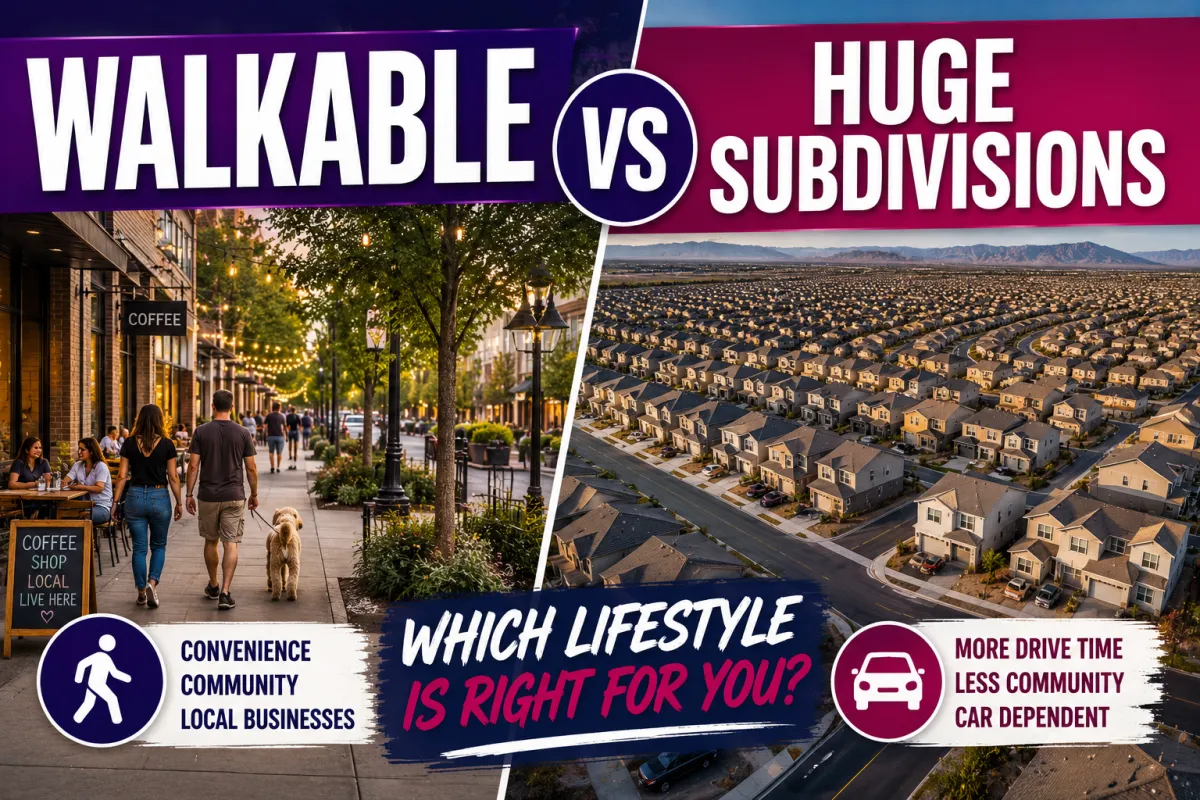
When the National Association of REALTORS® asked 2,000 Americans to choose between two communities, the results were clear. Fifty-nine percent chose the neighborhood with smaller yards where everything was within walking distance. Forty-one percent chose the large-yard neighborhood where driving was required for every errand.
That's not a close call. And it's a shift. In every prior version of this survey, going back to 2017, that split was 53/47. In 2026, it moved to 59/41.
Something is changing in what buyers want from the places they live. The Southeast Valley was built almost entirely around the model that 41 percent of buyers now say they prefer. That was the right model for the time. The question is whether it's the right model for the land that's still left to develop.
What the 2026 NAR Survey Actually Found
NAR's Community and Transportation Preferences Survey is conducted every three years. The 2026 version polled 2,000 adults across the 50 largest U.S. metro areas in May 2026, released July 10. The supporting numbers fill in a more complete picture of what buyers say they want.
Eighty-nine percent of respondents said sidewalks and places to take walks were very or somewhat important when deciding where to live. Eighty-two percent said being within easy walking distance of shops and parks mattered in their housing decision. Seventy-eight percent said having a community where children can safely walk or bike to school was important. Seventy-four percent said having a place nearby to walk or exercise a pet was a factor.
These aren't edge-case preferences. They're majority positions across the board.
On the question of walkability and cost, 77 percent of respondents who said walkability was important to them said they'd be willing to pay more to live in a community where they could walk to parks, shops, and restaurants. Twenty-two percent said they'd pay "a lot more." Fifty-six percent said they'd pay "a little more." Only 23 percent said they wouldn't pay anything extra for it.
When asked whether walkable homes actually cost more, 67 percent said yes. Buyers know the premium exists, and a significant majority say they're willing to accept it.
One number stands out above the rest for what it reveals about car-dependent communities: 62 percent of respondents said they drive because they don't have a lot of other options. Not because they want to. Because their community doesn't give them a choice.
What Walkable and Mixed-Use Actually Mean Here
A walkable neighborhood has connected streets that go somewhere. Sidewalks on most blocks. Short distances between homes and daily destinations. Lower traffic speeds. The ability to run an errand without starting a car.
Mixed-use development integrates residential, retail, and public space rather than separating them into disconnected pods. Townhomes near ground-floor retail. A plaza that gives residents a reason to be outside. A grocery or pharmacy woven into the neighborhood rather than anchored in a strip mall a mile away.
Neither of these requires high-rise density. Some of the stronger examples in Arizona are mid-scale: a town center with a few floors of residential above walkable shops, connected to single-family streets that link to daily destinations rather than dead-ending at cul-de-sacs.
The NAR data also speaks to what types of housing people think should be built. Sixty-three percent of respondents said building more small-lot single-family homes in their community was a good or very good idea. Fifty-one percent said townhomes, duplexes, and other attached housing were a good idea. These two housing types sit at the intersection of what buyers want and what walkable, mixed-use communities are built from.
How the Southeast Valley Got Built
Chandler's rapid expansion in the late 1990s and early 2000s followed a pattern that was standard across the Sun Belt at the time: large master-planned subdivisions, quarter-acre and half-acre lots, cul-de-sac street networks, and commercial development placed along major arterials in separate pods far from homes.
That model worked. Chandler grew from a small agricultural city into one of the most desirable addresses in the Phoenix metro. The schools are strong, the employers are substantial, and the infrastructure functions well. Buyers who came in during that era got good value and good communities.
But that development pattern also produced the problem that 71 percent of Americans now cite as the main reason they don't walk more: the places they need to go are too far away. That's not a personal failing. It's a design outcome. When shops are placed on arterials a mile from residential neighborhoods, and when the street network doesn't connect homes to destinations on foot, walking doesn't become a realistic daily option regardless of how much someone might want it.
The NAR survey makes this plain: 85 percent of respondents said they like walking. But 62 percent drive because they don't have other options. The gap between those two numbers isn't a preference problem. It's an infrastructure problem.
The Southeast Valley was built to require driving. That's not a criticism of the communities that exist. It's a description of how they were designed, and it was an accurate reflection of what was prioritized at the time. The relevant question now is what happens on the land that hasn't been developed yet.
The Last Patches of Land Are a Real Choice
Chandler is largely built out. Gilbert is approaching the limits of its developable acreage. The undeveloped parcels that remain in these cities are limited and genuinely valuable, not just in dollar terms but in terms of what they represent for long-term livability.
What gets built on that land will be there for 50 years or more. Building another conventional subdivision with cul-de-sacs and arterial commercial is one option. Building something that responds to what 59 percent of buyers now say they prefer is another.
This is a market argument, not just a planning one.The Phoenix metro housing market has shifted, and buyers have more room to negotiate than they've had in years.Developments that match what buyers actually want, based on current survey data, will compete for that buyer pool differently than projects that follow the same template from twenty years ago.
The shift from 53 percent to 59 percent preferring walkable communities isn't dramatic in isolation. But it's moved in one direction across every survey cycle. Preferences aren't reversing.
Mixed-use zoning, smaller block sizes, connected street grids, and ground-floor retail in the right locations can produce neighborhoods that feel and function differently. They don't need to look like downtown Scottsdale. They need to give residents an option they currently don't have in most of Chandler and Gilbert. Pockets of it already exist. Chandler's downtown and Gilbert's Heritage District show the model works here. The scale just doesn't match the demand.
What the Walkability Premium Means for Buyers
Sixty-seven percent of survey respondents already know walkable homes cost more. That perception is backed by consistent research showing that walkable neighborhoods command a premium over comparable car-dependent homes in the same metro area.
For buyers thinking about long-term value, the community design matters beyond the house itself. A neighborhood where residents can walk to daily amenities and where the streets create some sense of place tends to hold its appeal with a broader pool of future buyers.Monthly payment math is still the central constraint for most buyers right now, and paying a premium for walkability is a real cost. But it's also a decision that tends to be reflected in resale competition over time.
The Southeast Valley doesn't have a lot of walkable inventory at any price point.Most buyers working within a reasonable budget are shopping in car-dependent communitiesbecause that's what the market offers. As more mixed-use development comes online in the region, buyers who get into those communities early tend to see stronger appreciation than comparable buyers in conventional subdivisions.
What Buyers Should Do Now
If walkability matters to you in a Southeast Valley home search, evaluate it practically rather than relying on how a community looks on a listing.
Start with the street layout. Connected street grids support real walkability. Cul-de-sac networks usually don't, no matter how close shops appear on a map.
Check actual walking distances. A 20-minute walk covers about a mile on flat ground. If a park, grocery store, or coffee shop is within that range via safe sidewalks, the location delivers. If the closest useful destination requires a car regardless of distance, it doesn't.
Look at what's planned for undeveloped land nearby. What gets zoned and developed on adjacent parcels will shape your daily life for as long as you own the home.First-time buyers especially should think about what the neighborhood will look like in five to ten years, not just on closing day.
Mixed-use zoning on nearby parcels signals that walkability may improve. Conventional large-lot or arterial commercial zoning suggests the existing pattern will continue.
Frequently Asked Questions
What did the 2026 NAR Community and Transportation Preferences Survey find about walkable neighborhoods?
The survey found that 59 percent of respondents prefer a community with smaller lots and walkable access over one with larger lots requiring driving for every errand, up from 53 percent in prior survey years. Eighty-nine percent said walkable access was important when deciding where to live. Seventy-seven percent of those who value walkability said they'd pay more for it. And 62 percent said they drive primarily because they don't have other options.
Why doesn't the Southeast Valley have more walkable communities?
Most of the region was built when car-based suburban design was the dominant model. Large lots, cul-de-sac street networks, and commercial strips along arterials far from homes were standard practice. That infrastructure works but doesn't support walking as a daily option. The NAR survey found that 71 percent of Americans say the places they need to go are too far to walk. That's a direct result of how communities like these were designed.
What housing types do Americans actually want to see built?
The 2026 NAR survey found that 63 percent of respondents said building more small-lot single-family homes was a good or very good idea. Fifty-one percent said townhomes, duplexes, and attached housing were a good idea. These housing types sit at the core of mixed-use, walkable community design. Support for these options was higher than support for large-lot single-family homes (48 percent) or rental apartments (44 percent).
Do walkable homes actually cost more in the Phoenix area?
Sixty-seven percent of NAR survey respondents said they believe walkable homes cost more. Research backs that. Walkable neighborhoods consistently command a premium in markets where they're available. In the Southeast Valley, walkable inventory is limited, but homes near the existing pockets of walkable access in Chandler's downtown and Gilbert's Heritage District tend to attract broader buyer competition.
What should buyers look for when evaluating a community's walkability?
Look at the street layout first. Connected street grids support walkability; cul-de-sac networks don't, regardless of what's nearby. Then check what's actually reachable via sidewalk in about a 20-minute walk. Parks, grocery stores, coffee shops, and schools within that range indicate a walkable location. Also look at zoning and planned development on adjacent parcels, since what gets built nearby will shape the neighborhood's character and function for years.
Is there a movement toward more mixed-use development in the Southeast Valley?
There's increasing pressure in that direction. Available land in Chandler and Gilbert is running out, and decisions made now will determine what the region looks like for the next several decades. Some developers and municipalities are responding to buyer demand for more connected, walkable design. Whether that becomes the dominant pattern depends on zoning, developer investment, and sustained buyer demand for something different from the standard subdivision model.
Source: National Association of REALTORS® 2026 Community and Transportation Preferences Survey, conducted May 4-16, 2026, released July 10, 2026. 2,000 respondents across 50 major U.S. metropolitan areas. Margin of error ±2.2 percentage points. Published July 2026 | Home Buying | Southeast Valley, Arizona.