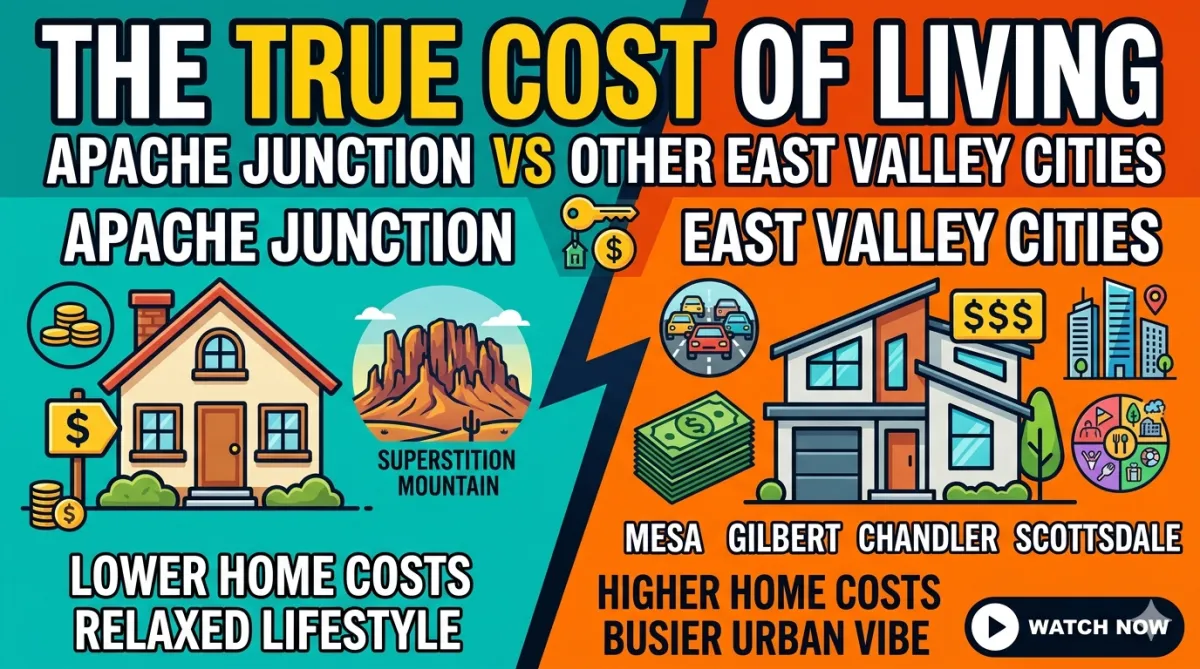
The True Cost of Living in Apache Junction vs Other East Valley Cities
The True Cost of Living in Apache Junction vs Other East Valley Cities
Home Prices Are Usually the First Thing People Notice1
Your Mortgage Payment Is Only Part of the Story2
Utility Bills Can Surprise People3
Transportation Costs Depend Heavily on Your Routine4
Grocery Stores, Restaurants, and Daily Spending Feel Different Here5
Outdoor Living Helps Balance Entertainment Costs6
Property Taxes and HOA Costs Can Feel More Manageable7
First-Time Buyers Often Feel Less Financial Pressure Here8
The Emotional Cost of Living Matters Too9
The Right Answer Depends on Your Lifestyle10
A lot of people move to Apache Junction because they think it will simply be cheaper.
And at first glance, it usually is.
You start comparing home prices against places like Gilbert, Chandler, Mesa, or Queen Creek, and Apache Junction immediately stands out because the numbers look more manageable. Lower purchase prices. Lower property taxes in some cases. More chances to actually find a home with space without feeling financially squeezed the second you move in.
But the real conversation gets more interesting once you look beyond the listing price.
Because the true cost of living somewhere is not just about what you pay for the house itself. It is about what your day-to-day life feels like financially once you are actually settled in.
Your commute matters.
Your utility bills matter.
How often you drive across town matters.
Whether your weekends feel expensive matters.
Whether you constantly feel stretched financially after your mortgage payment matters a lot.
And honestly, that is where Apache Junction starts separating itself from some other East Valley cities in ways buyers do not always expect at first.
Some people move here because they want affordability. Others move here because they want breathing room. A quieter pace. Less pressure to keep up with expensive neighborhoods, newer developments, or lifestyles that quietly drain your budget every month.
That does not mean Apache Junction is perfect for everybody.
It just means the financial experience of living here feels different compared to many nearby cities.
And if you are trying to decide whether Apache Junction actually saves money long term, or if the lower home prices come with tradeoffs that affect daily life, you really need to look at the full picture instead of just comparing Zillow screenshots.
Home Prices Are Usually the First Thing People Notice
This is the obvious starting point because it is usually the reason buyers begin looking at Apache Junction in the first place.
Compared to many East Valley cities, Apache Junction still gives buyers more opportunities to enter the market without pushing their monthly payment into uncomfortable territory.
That matters right now because affordability conversations are happening everywhere across Arizona.
A buyer looking at homes in Gilbert or Chandler can quickly end up staring at prices that feel difficult to justify once monthly payments, taxes, insurance, and interest rates all get added together. Apache Junction often gives those same buyers a chance to stay within budget while still buying a detached home with actual yard space and usable square footage.
And for many people, that changes the entire conversation emotionally.
Instead of stretching to the absolute edge of what they can afford, buyers sometimes feel like they can finally exhale a little here.
That feeling matters more than people realize.
You can see this especially clearly when looking at homes under $500K, where it becomes obvious there are still neighborhoods and property types that feel realistic for middle-income buyers rather than being completely out of reach.
That does not automatically mean Apache Junction is “cheap,” though.
Arizona prices overall have changed a lot in recent years. What buyers often mean is that Apache Junction still feels more attainable compared to many surrounding East Valley areas where entry-level pricing has climbed aggressively.
Your Mortgage Payment Is Only Part of the Story
This is where people sometimes make mistakes when comparing cities.
They focus heavily on purchase price without thinking enough about monthly lifestyle costs afterward.
Because yes, buying a house for less money helps. Obviously.
But your overall cost of living is also shaped by what daily life requires from you once you move there.
For example, some East Valley cities naturally encourage more spending simply because of the environment around you. Newer master-planned communities often come with higher HOA fees, higher expectations for landscaping upkeep, more expensive shopping habits nearby, and social pressure that quietly increases spending over time.
People do not always notice this immediately.
But after living somewhere for a while, it adds up.
Apache Junction tends to feel more relaxed financially in comparison.
There is less pressure to constantly upgrade everything.
Less pressure to compete visually with neighbors.
Less pressure to maintain a certain lifestyle image.
That may not sound dramatic, but it affects people more than they think. Especially families trying to balance rising grocery costs, childcare expenses, car payments, insurance increases, and everyday inflation that seems to hit every category at once.
In Apache Junction, many residents appreciate that life can feel a little more practical overall.
You still have access to restaurants, shopping, hiking, and East Valley conveniences, but daily life often feels less consumption-driven compared to some higher-priced suburban areas nearby.
Utility Bills Can Surprise People
This is one area buyers do not always think about enough before moving to Arizona in general.
Summer utility bills matter here. A lot.
And depending on the house, air conditioning costs can become a serious monthly expense during peak summer months.
Older homes in Apache Junction sometimes come with less energy-efficient windows, insulation, or HVAC systems compared to newer builds in parts of Chandler or Queen Creek. That can raise electric bills if the property has not been updated.
At the same time, newer East Valley homes often come with larger square footage, higher ceilings, more elaborate landscaping irrigation systems, and bigger overall cooling demands.
So the answer is not always straightforward.
Sometimes a smaller Apache Junction home with practical layouts ends up costing less monthly to maintain than a giant newer suburban house with soaring ceilings and massive cooling needs.
This is why buyers really need to evaluate homes individually instead of assuming one city automatically guarantees lower monthly expenses.
The home itself matters just as much as the ZIP code.
Transportation Costs Depend Heavily on Your Routine
This is one of the biggest real-world factors people either love or struggle with after moving to Apache Junction.
Your commute changes everything.
If your work, school routines, or social life constantly pull you deep into Phoenix, Scottsdale, Tempe, or central Chandler, transportation costs can climb quickly. More fuel. More driving time. More wear on your vehicle.
And honestly, some people underestimate how tiring long East Valley driving routines become over time.
On the other hand, buyers who work remotely, work nearby, or simply prefer a quieter home-centered lifestyle often feel perfectly happy with Apache Junction’s location because the tradeoff feels worth it financially and emotionally.
You get more space. Lower home pricing. Less density. Better mountain views in many areas. A calmer pace.
That works extremely well for some people.
Others eventually realize they personally prefer being closer to the center of the Valley even if housing costs more there.
Neither answer is wrong.
This is less about finding the universally “best” city and more about figuring out which daily rhythm actually fits your life.
Grocery Stores, Restaurants, and Daily Spending Feel Different Here
Something interesting happens when people move from higher-cost East Valley areas into Apache Junction.
Their spending habits often shift naturally.
Not because they are trying to save money aggressively. The environment just feels different.
In some East Valley suburbs, daily life revolves heavily around newer shopping centers, trend-driven restaurants, luxury gyms, entertainment districts, and higher-end retail environments. People spend money almost by accident because everything around them encourages it constantly.
Apache Junction feels more grounded overall.
You still have local restaurants, coffee shops, and community spots people genuinely enjoy, but the overall vibe feels less centered around constant consumer activity.
A Saturday here might look more like grabbing coffee, hiking nearby trails, running errands, and heading home instead of spending an entire afternoon moving between upscale shopping centers and expensive restaurants.
That slower pace naturally changes monthly spending for a lot of households.
And honestly, many people end up preferring that once they experience it for a while.
Outdoor Living Helps Balance Entertainment Costs
One underrated thing about Apache Junction is how much free or low-cost outdoor access shapes everyday life.
When people picture entertainment expenses, they often think about malls, attractions, events, or dining out constantly. But many Apache Junction residents spend their free time outside instead.
That changes things financially.
You have hiking trails nearby. Desert scenery everywhere. State parks within easy reach. Outdoor photography spots. Scenic drives. Places where people can spend hours without spending much money at all.
Families who enjoy outdoor activities often find Apache Junction fits their lifestyle naturally because weekends do not have to revolve around expensive entertainment.
That is part of why local outdoor access becomes such a major quality-of-life factor for long-term residents, as many people who enjoy the places covered in Outdoor Spots often find themselves using local outdoor spaces regularly instead of paying for weekend entertainment.
That balance helps many households feel less financially stretched overall.
Property Taxes and HOA Costs Can Feel More Manageable
This depends heavily on the neighborhood and property type, but Apache Junction often appeals to buyers who want fewer ongoing community fees compared to newer master-planned developments elsewhere in the East Valley.
Some buyers get tired of extremely strict HOA environments.
Others simply want lower monthly obligations overall.
Now, that does not mean every Apache Junction neighborhood is HOA-free or automatically inexpensive. But compared to certain newer East Valley communities with large HOA structures, expensive amenities, and highly controlled neighborhood standards, Apache Junction can sometimes feel financially lighter month to month.
And for buyers on fixed incomes, retirees, first-time buyers, or families trying to keep long-term expenses manageable, those differences matter.
Especially now.
First-Time Buyers Often Feel Less Financial Pressure Here
This is a big reason Apache Junction keeps showing up in conversations among younger buyers and first-time homeowners trying to enter the Arizona market without completely exhausting themselves financially.
Buying your first house already feels stressful enough.
People are juggling down payments, closing costs, inspections, moving expenses, furniture costs, rising insurance rates, and the fear of making a bad decision.
In more expensive East Valley cities, many buyers feel financially stretched from day one.
Apache Junction can sometimes ease that pressure simply because the barrier to entry may feel slightly more achievable depending on the market and property type.
For buyers trying to bridge the affordability gap, programs discussed in Down Payment can sometimes help make homeownership feel more realistic than many renters initially assume.
That matters because many renters across Arizona are stuck in this strange position where monthly rent already feels expensive enough to equal a mortgage payment, but saving for the upfront buying costs still feels difficult.
Apache Junction tends to stay part of the conversation because it still offers some flexibility compared to areas where entry pricing has accelerated much faster.
The Emotional Cost of Living Matters Too
People rarely talk about this part enough.
But financial stress affects your life constantly once you move somewhere.
If your mortgage payment leaves you anxious every month, that changes your day-to-day experience.
If your commute drains you. If your neighborhood constantly pressures higher spending. If you feel financially stretched every weekend. If every unexpected repair creates panic.
That stuff adds up emotionally fast.
Some buyers willingly accept higher costs because they value shorter commutes, newer neighborhoods, top-rated amenities, or proximity to work hubs. And for them, the higher cost absolutely makes sense.
Others eventually realize they would rather have slightly older homes, more desert surroundings, and fewer luxury conveniences if it means having more breathing room financially each month.
Apache Junction often appeals strongly to people in that second group.
People who care more about livability than image.
People who want their money to go farther without feeling like they are sacrificing everything good about Arizona living.
The Right Answer Depends on Your Lifestyle
This is really what the conversation comes down to.
If you want highly polished master-planned living with newer retail centers, dense amenities, and a more upscale suburban presentation, cities like Chandler, Gilbert, and Queen Creek may feel more aligned with your goals.
If you want lower entry pricing, more breathing room, outdoor access, mountain views, and a less financially intense day-to-day lifestyle, Apache Junction often starts making a lot of sense.
Neither choice is automatically better.
The bigger question is what kind of financial life you actually want after the excitement of moving wears off.
Do you want lower monthly pressure?
Do you care more about location convenience?
Would you rather have more house or a shorter commute?
Would you rather spend money on travel, hobbies, and flexibility instead of pouring every extra dollar into housing costs?
Those answers usually point people toward the right city faster than online rankings ever will.
Weaving together all these moving pieces makes conversations around good time a natural part of the process, especially as affordability, interest rates, inventory, and long-term plans all continue to influence each other.
Final Thoughts
The true cost of living in Apache Junction is not just about whether homes are cheaper.
It is about how your overall life feels financially once you are there.
For some people, Apache Junction feels like relief. Less pressure. More space. More manageable monthly costs. A slower pace that actually lets them enjoy Arizona instead of constantly trying to keep up financially.
For others, the tradeoffs around commute times, older housing stock, or distance from major job centers may feel less ideal.
That is why this decision works best when people stop treating cities like scorecards and start thinking honestly about their actual day-to-day routines.
Because where you live shapes your spending habits, your stress levels, your weekends, your commute, and even how much margin you feel financially month to month.
And once buyers get honest about the lifestyle they truly want, Apache Junction usually either clicks immediately… or it does not.
Most of the time, people know pretty quickly which side they are on.
About the Author
Nancy Wittenberg is an Apache Junction, Arizona real estate agent with Coldwell Banker Realty who helps buyers and homeowners move forward with clarity and confidence. She is the creator of the Buyer Care Plan™, a step-by-step approach designed to guide buyers through the home-buying process with education and support.
Nancy works with both buyers and sellers throughout Apache Junction and the surrounding East Valley, helping homeowners sell with strategic preparation while guiding buyers through their next move.