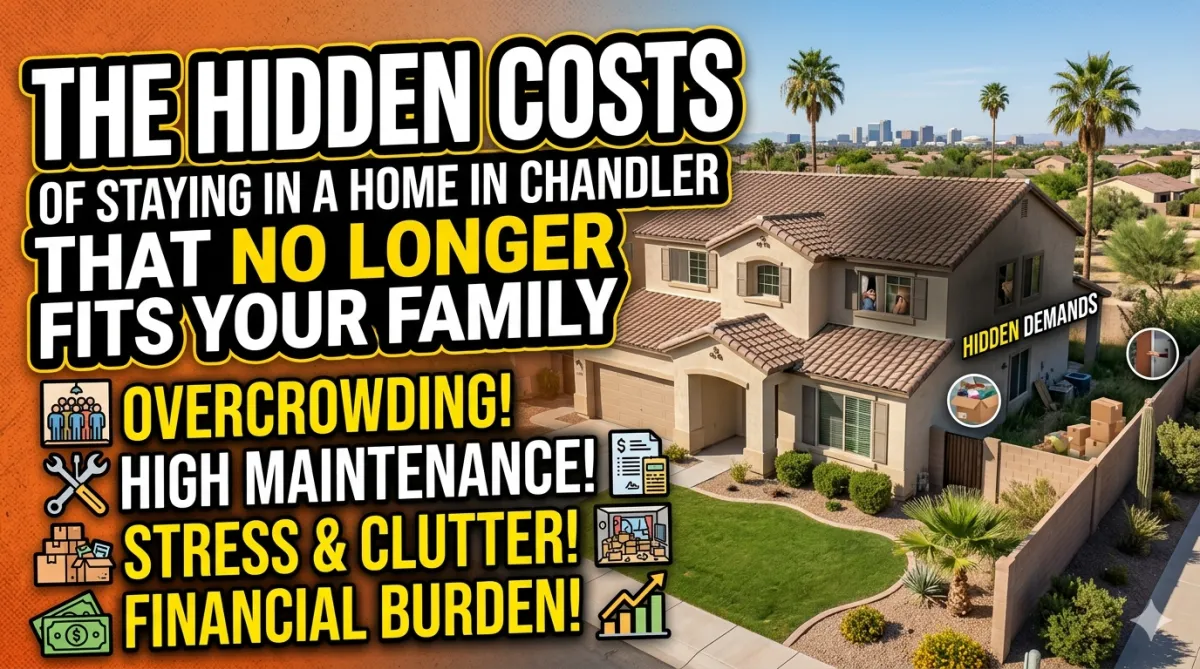
The Hidden Costs of Staying in a Home in Chandler That No Longer Fits Your Family
The Hidden Costs of Staying in a Home in Chandler That No Longer Fits Your Family
A House Can Be Too Small Without Being Tiny 1
The Financial Cost Is Not Always What People Think 2
Daily Frustration Adds Up Faster Than People Realize 3
Sometimes the Problem Is the Layout, Not the Size 4
Your Home Should Fit the Life You Have Now 5
Staying Too Long Can Affect Opportunities Later 6
Your Neighborhood Matters Too 7
Fear Keeps a Lot of People Stuck 8
There May Be More Options Than You Think 9
The Emotional Weight Is Real Too 10
Sometimes the Best Move Is Simply Being Honest About What Is Not Working 11
There comes a point where a house that once felt perfect starts feeling harder to live in.
And usually, it happens slowly.
At first, maybe it is just a little annoying that the kitchen feels crowded every morning. Then the garage gets so packed that nobody wants to deal with it anymore. Maybe one kid is sharing a room longer than planned. Maybe you started working from home and now your “office” is a corner of the dining room table that never actually gets cleared off.
A lot of Chandler homeowners stay in homes that no longer fit because technically, the house still works.
You can still sleep there. You can still make it function. You can still convince yourself it is “fine for now.”
But after a while, the hidden costs start showing up in ways people do not always expect.
And I am not just talking about money.
Sometimes the biggest cost is stress. Frustration. Feeling cramped all the time. Feeling disconnected from the lifestyle you actually want.
That is usually the part people underestimate.
A House Can Be Too Small Without Being Tiny
One of the most common things homeowners say is, “We thought we could make it work longer.”
And honestly, sometimes they can… for a while.
A couple buys a starter home in Chandler when life looks completely different. Maybe it made perfect sense at the time. Lower payment. Smaller maintenance list. Easy decision.
Then life changes.
Kids get older. Someone starts working remotely. Parents move in temporarily that turns into permanently. Hobbies take over space. Sports equipment multiplies. Pets get bigger. Schedules get busier.
Suddenly, the home that once felt cozy starts feeling tight all the time.
The hard part is that most people adjust gradually, so they do not always realize how much the house is affecting their daily routine until they finally get more space and think, “Wow… this feels easier.”
That feeling matters more than people think.
Because your home affects your stress level every single day. If every room feels crowded, if storage is constantly overflowing, if there is nowhere quiet to go, it wears on you over time.
Especially in busy Chandler households where everyone already has full schedules.
The Financial Cost Is Not Always What People Think
A lot of homeowners stay put because they are afraid moving will cost too much.
That concern is understandable, especially with interest rates getting so much attention lately. But sometimes people focus so hard on the cost of moving that they completely ignore the cost of staying stuck.
That part deserves a closer look.
When a home no longer fits your family well, people often start spending money trying to compensate for the limitations of the house itself.
Maybe you rent a storage unit because the garage is full.
Maybe you spend money constantly reorganizing spaces that still do not work.
Maybe you avoid hosting family because the layout feels cramped.
Sometimes homeowners start pouring money into small projects hoping the house will suddenly feel different afterward. A patio extension here. More garage cabinets there. A room conversion that sort of helps but still does not fully solve the issue.
And after enough patchwork upgrades, many people realize they have spent a lot of money trying to force a home to become something it was never designed to be.
That does not automatically mean moving is the answer for everyone. But it does mean staying has costs too.
They are just quieter costs.
Daily Frustration Adds Up Faster Than People Realize
This is the part people usually minimize.
They tell themselves they are being dramatic.
But if your home creates friction every single day, eventually it starts affecting your mood, your patience, and even your relationships inside the home.
You feel it in the mornings when everyone is trying to get ready at once.
You feel it when there is nowhere to escape for quiet time.
You feel it when clutter becomes permanent because there simply is not enough storage.
You feel it when kids have nowhere to spread out for homework or activities.
And you especially feel it when the home stops feeling peaceful.
That is a big one.
A house does not have to be luxurious to feel calm. But when a home consistently feels chaotic, crowded, or difficult to function in, people carry that stress with them more than they realize.
I have seen families in Chandler move into homes with slightly better layouts, more usable space, or better flow and immediately say life feels easier. Not perfect. Just easier.
That matters.
Sometimes the Problem Is the Layout, Not the Size
This catches a lot of homeowners off guard.
A house can technically have enough square footage and still feel wrong for your lifestyle.
Older floor plans sometimes have formal dining rooms nobody uses anymore while the actual living areas feel cramped. Some homes have tiny kitchens that become frustrating if multiple people are always in them. Others have awkward split layouts that make remote work or multigenerational living harder than expected.
You can feel crowded in a 2,500-square-foot home if the layout works against your daily life.
That is why buyers today often care more about functionality than just total square footage.
Open living spaces, flexible bonus rooms, better storage, and separate work areas can completely change how a home feels day to day.
And honestly, this is part of why so many Chandler buyers spend time researching different neighborhoods and housing styles before making a move. A newer floor plan in one community may fit a family much better than an older layout somewhere else, even at a similar size.
If outdoor space, walkability, and having more places to actually enjoy time together outside the house are starting to matter more to your family, spending time in different parts of Chandler can help you figure out which areas genuinely fit your lifestyle instead of only focusing on square footage or the house itself.
Your Home Should Fit the Life You Have Now
A lot of people stay emotionally attached to the version of life they had when they bought the home.
That is normal.
Maybe it was your first house. Maybe you brought your baby home there. Maybe it represents a season of life that mattered a lot to you.
But sometimes families outgrow homes emotionally before they fully admit it practically.
The routines change.
The priorities shift.
What mattered five years ago may not be what matters now.
And there is nothing wrong with that.
I think some homeowners quietly feel guilty for wanting something different. Like they are being ungrateful because the house is “still nice.”
But wanting a home that better supports your family is not being ungrateful.
It is being honest.
Staying Too Long Can Affect Opportunities Later
Another hidden issue people do not always think about is timing.
Some homeowners wait so long to make a move that they end up making decisions under pressure later instead of on their own terms.
For example, maybe the family grows faster than expected. Maybe a job change suddenly shortens the timeline. Maybe aging parents need to move in unexpectedly. Maybe teenagers sharing rooms finally becomes a breaking point.
Now the move feels urgent instead of strategic.
That can create more stress than necessary.
Sometimes people also stay because they assume they cannot afford something larger, only to discover later they actually had more options than they realized. Especially in areas where different price points, neighborhoods, and financing programs create more flexibility than buyers expect.
That is why many homeowners quietly start looking at what is actually available in their price range long before they officially decide to move. It helps them get a clearer picture of the market instead of relying on headlines, social media opinions, or assumptions about what they think they can afford.
Your Neighborhood Matters Too
Sometimes the issue is not just the house.
Sometimes it is the overall lifestyle around it.
Maybe the neighborhood felt perfect when your kids were toddlers, but now your daily routine looks completely different. Maybe the commute is wearing you down. Maybe you want more walkability, more parks, better proximity to restaurants, or easier access to weekend activities.
Chandler has a lot of variety depending on where you live.
Some areas feel quieter and more suburban. Others feel more connected to shopping, dining, and entertainment. Some neighborhoods work better for commuters. Others feel more family-centered or outdoor-focused.
As your life changes, the neighborhood that once fit perfectly may not feel as natural anymore.
That does not mean there is something wrong with the area.
It just means your lifestyle evolved.
And honestly, this is one of the biggest reasons people eventually move even when they originally planned to stay much longer.
Fear Keeps a Lot of People Stuck
This part rarely gets talked about openly.
A lot of homeowners know their current home no longer works well. They just feel overwhelmed by the idea of making a move.
Selling sounds stressful.
Buying sounds competitive.
Interest rates feel confusing.
The thought of coordinating everything feels exhausting.
So people delay the conversation.
And sometimes that delay stretches into years.
I completely understand why.
But avoiding the conversation usually does not make the problem smaller. It just keeps families living in a situation that may already be creating stress every day.
Sometimes what actually helps is simply getting clearer information instead of trying to figure everything out alone online.
That is why many homeowners start researching the market long before they plan to make a move. They are not necessarily buying tomorrow — they just want a realistic understanding of what the current market looks like for families in Chandler right now.
There May Be More Options Than You Think
One thing that surprises many homeowners is how many possible paths exist once they finally sit down and look at the numbers carefully.
Some people assume they need a massive down payment to move into a better-fitting home when that is not always true.
Some homeowners discover they have built more equity than expected.
Others realize certain monthly expenses tied to their current home are already eating into their budget enough that moving changes the overall picture more than anticipated.
And for buyers who are transitioning out of a starter-home phase into something that better fits their growing family, certain financing and assistance opportunities can sometimes open doors they did not even realize were possible.
That does not mean every situation works financially.
But it does mean assumptions are not always accurate either.
The Emotional Weight Is Real Too
People talk about square footage all the time.
They do not talk enough about emotional exhaustion.
Living in a house that constantly feels difficult can slowly wear people down. Especially parents who already carry a lot mentally every day.
When your environment feels stressful, cluttered, cramped, or chaotic, it becomes harder to recharge at home.
And home is supposed to be the place where you exhale a little.
That is why some families move and immediately say they wish they had done it sooner.
Not because the new home is perfect.
Not because bigger automatically means happier.
But because the home finally supports the life they are actually living now instead of the life they had years ago.
That difference is bigger than people expect.
Sometimes the Best Move Is Simply Being Honest About What Is Not Working
You do not have to rush into selling your house tomorrow.
You do not need to panic-buy another one either.
But if your current home no longer fits your family well, it is probably worth being honest about that instead of automatically dismissing the feeling.
Because staying put has costs too.
Some are financial.
Some are emotional.
Some show up quietly over time in your stress levels, routines, and overall quality of life.
And sometimes the smartest thing a homeowner can do is stop asking, “Can we survive here longer?” and start asking, “Does this home still support the life we actually want?”
That is usually when the conversation becomes much clearer.
About the Author
Nancy Wittenberg is an Arizona real estate agent with Coldwell Banker Realty who helps buyers and homeowners throughout Chandler, Ahwatukee, and the East Valley move forward with clarity and confidence. She is the creator of the Buyer Care Plan™, a step-by-step approach designed to help buyers understand the process without feeling overwhelmed. Nancy works closely with families who are trying to figure out when it makes sense to move, stay, upsize, or simplify based on their real-life goals, not just market headlines.