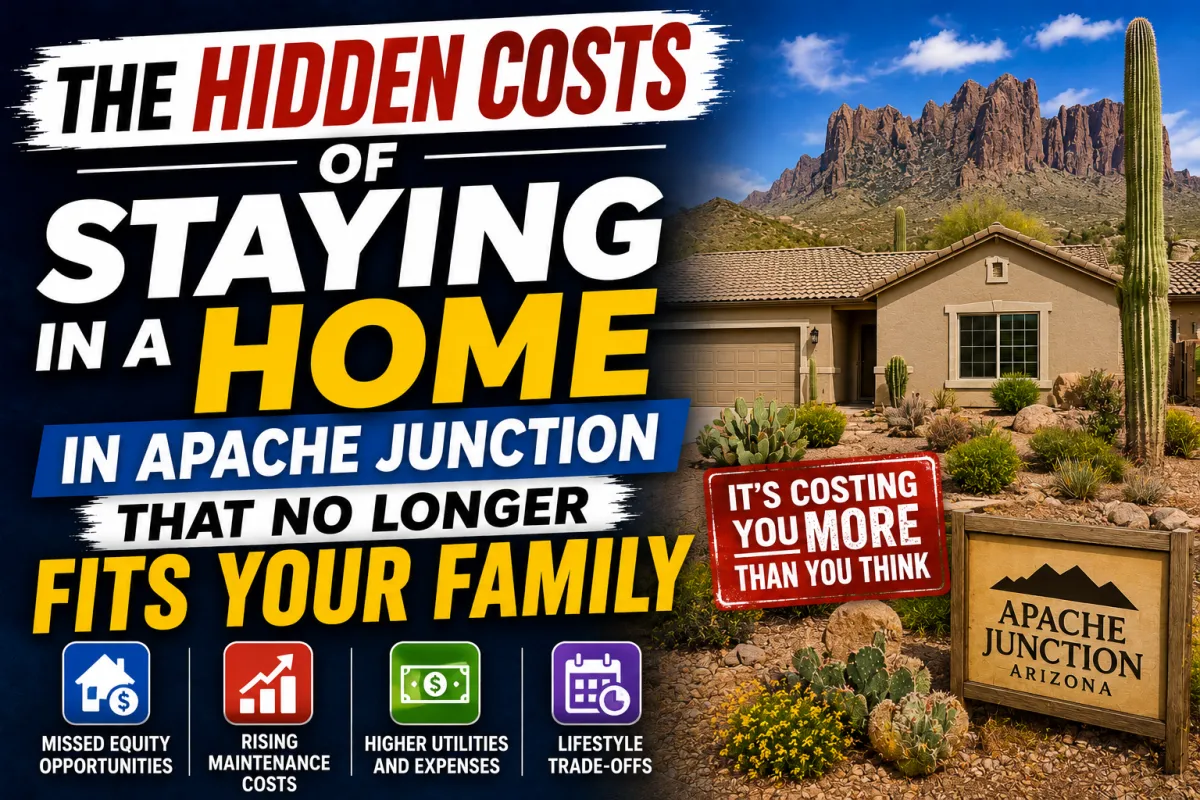
The Hidden Costs of Staying in a Home in Apache Junction That No Longer Fits Your Family
The Hidden Costs of Staying in a Home in Apache Junction That No Longer Fits Your Family
Start here, not with the house, but with your day 1
Space that doesn’t match your life anymore 2
Emotional fatigue that builds quietly 3
Maintenance starts feeling like a second job 4
Time loss that doesn’t show up on paper 5
The financial trade you might not notice 6
Apache Junction has its own tradeoffs 7
When staying actually makes sense 8
When it starts making more sense to move 9
A simple way to think about it 10
A lot of people don’t wake up one day and suddenly hate their house.
It usually builds slowly.
One day the kitchen feels a little tight. Then the kids start outgrowing rooms. Then the commute starts to feel longer than it used to. Before you know it, the place you once loved just doesn’t match how your life looks now.
And in Apache Junction, that feeling can be even more confusing because the area itself still makes sense on paper. Affordable homes, mountain views, quieter streets, easy access to outdoor spaces. It still checks boxes.
But your life might have changed faster than the house did.
That gap is where most of the hidden costs show up.
Not obvious costs. Not the kind you see on a spreadsheet. The kind you feel during normal days when things are just slightly harder than they should be.
Start here, not with the house, but with your day
Before talking about money or upgrades, think about a normal weekday.
Morning rush. Getting ready. Trying to find things that always seem to disappear at the worst time. School drop-offs. Work. Dinner. Evening downtime that never feels like enough time.
Now imagine doing all of that in a home that no longer fits your rhythm.
Maybe there’s not enough space for everyone to move without bumping into each other. Maybe storage has turned into a daily frustration. Maybe one bathroom just isn’t cutting it anymore.
It’s not dramatic. It’s just tiring in a quiet way.
That’s usually the first real cost people ignore. Energy. Not financial, but personal.
And once that starts stacking up, everything else starts feeling heavier too.
Space that doesn’t match your life anymore
This is the most common one.
A home that worked five or ten years ago might not work now. Families grow. Work setups change. Kids need more privacy. Sometimes parents move in. Sometimes you just collect more life than the house was built for.
In Apache Junction, you’ll find a lot of homes that were built with a simpler layout in mind. That can be great when your needs are simple. But when life gets more layered, the walls start to feel closer than they used to.
You notice it in small ways first.
A cluttered living room that never really resets. A dining area that doubles as storage. A bedroom that tries to be an office but never fully works as one.
At some point, you stop rearranging furniture because you know it won’t fix the problem.
This is usually the point where people start checking what’s out there under 500k price range, just to see if something else would actually fit their life better. Not because they’re chasing something fancy, but because they want a home that feels easier to live in without always having to adjust things around.
Emotional fatigue that builds quietly
This one gets overlooked a lot.
People think moving is stressful, so staying must be easier. Sometimes it is. But not always.
Living in a space that doesn’t fit your daily life creates a slow kind of frustration. You don’t always notice it in the moment. It shows up in your mood, your patience, and how you feel at the end of the day.
Little things start to annoy you more than they should. The house feels messy faster. You feel like you’re always catching up instead of staying ahead.
It’s not about the house being bad. It’s about it not supporting your life anymore.
And when that goes on long enough, the home stops feeling like a place to recharge. It just becomes another thing you manage.
People rarely factor this into the cost of staying, but it’s real. And over time, it matters more than most physical upgrades.
Maintenance starts feeling like a second job
Every home needs upkeep. That’s normal.
But older or smaller homes that are already stretched beyond their ideal use can start demanding more attention than expected.
Maybe the layout makes cleaning harder. Maybe storage issues lead to clutter buildup. Maybe small repairs get delayed because life is already full.
In Apache Junction, many homes are more established, which is great for affordability and character. But older systems, layouts, or design choices can start to feel more noticeable when your household demands increase.
What used to be “normal upkeep” starts feeling like constant catch-up.
And once maintenance becomes something you think about every week, it changes how you feel about staying long-term.
At that point, a lot of people start weighing whether it makes more sense to fix up what they have or start looking at other options. That’s usually when they begin asking bigger timing questions about the market instead of just focusing on the next repair.
Because sometimes the question isn’t “how do we fix this house” but “does it still make sense to keep fixing this house.”
Time loss that doesn’t show up on paper
Time is one of the biggest hidden costs, but it rarely gets discussed clearly.
A home that doesn’t fit your life often slows you down in small ways.
Longer mornings because things are harder to organize. Extra trips because storage doesn’t support your routine. More time cleaning because spaces don’t stay functional.
Even the layout of the house matters more than people think. If rooms don’t flow well or storage is awkward, you spend more time just moving through your own space.
It adds up.
Not in one big dramatic way, but in a thousand tiny interruptions throughout the week.
And when life is already busy, that lost time starts to feel like pressure you can’t quite name.
The financial trade you might not notice
Here’s where things get more concrete.
Staying in a home that no longer fits your family can quietly lock up financial flexibility.
Not because the home is bad, but because it’s not doing much for your next stage of life.
Maybe you’ve built equity. Maybe the value has increased over time. But if you’re not using that equity to improve your situation, it’s just sitting there.
Meanwhile, you might be spending money patching together solutions. Storage units. Small renovations that don’t fully solve the issue. Temporary fixes that buy time but not clarity.
There’s also the opportunity cost. If your home could help you move into something that actually supports your life better, staying can sometimes delay that shift longer than necessary.
For some families, this is also when financing help options come into the conversation because it can make homes feel reachable that didn’t seem possible before. It shifts the numbers in a way that makes moving feel a lot more doable instead of overwhelming.
Not always. But often enough that it’s worth looking at.
Apache Junction has its own tradeoffs
Apache Junction is one of those places that people either really appreciate or slowly grow out of, depending on what life looks like.
There’s a lot to like.
You’re close to the Superstition Mountains. Outdoor access is right there. The pace is slower compared to more central parts of the Valley. And for many people, that’s exactly the point.
It’s also one of the more affordable pockets in the East Valley, which is a big reason families stay longer than they planned.
If you’re someone who values space, views, and a quieter feel, Apache Junction still makes a lot of sense.
But here’s the part people don’t always say out loud.
Commutes can stretch longer than expected depending on where you work. Some neighborhoods don’t evolve at the same pace as your needs. And if your family dynamic changes, the same home that once felt comfortable can start to feel limiting.
That’s where lifestyle matters more than price.
You can still enjoy the parks and outdoor areas nearby and genuinely like where you live, but that doesn’t really solve the issues that are building up inside the house itself.
Both things can be true at the same time.
When staying actually makes sense
Staying isn’t the wrong choice by default.
There are situations where it’s the smarter move.
If your home still supports your daily life with only minor friction, staying might be the best option. If your financial timing isn’t right yet, that matters too. If you’re planning upgrades that will realistically solve the problem, that’s valid.
Sometimes people rush into moving when they really just needed better organization or a small renovation.
But the key is honesty.
If you’ve already tried to adapt the space and it still doesn’t feel right, that’s usually a sign the issue isn’t temporary anymore.
When it starts making more sense to move
There’s no perfect moment. It usually just becomes obvious over time.
You start noticing that future plans don’t match your current space. Or you find yourself browsing homes just to imagine what life could feel like differently. Or conversations at home start circling around the same frustrations again and again.
That’s usually the turning point.
Not one big decision. Just repeated awareness that your current setup isn’t keeping up anymore.
At that point, it’s less about leaving and more about alignment. Finding something that fits your actual life instead of your past one.
A simple way to think about it
Forget the market for a second.
Forget interest rates, timing, and trends.
Ask a simpler question.
Does your home make your life easier or harder most days?
Not once in a while. Most days.
If it makes things harder, even in small ways, that’s the real hidden cost. Not obvious. Not dramatic. Just constant.
And that’s usually what pushes people to start exploring options, even if they weren’t planning to.
Final thoughts
Staying in a home that no longer fits isn’t just a housing decision. It shapes your time, your energy, and how your days actually feel.
Apache Junction still offers a lot of value, especially for people who want space, affordability, and access to nature. But your home still has to match your current life, not your past one.
And when those two things stop lining up, the cost isn’t always visible right away. It shows up in stress, in clutter, in time, and in how often you feel like you’re just trying to keep up.
At the end of the day, it’s not about rushing into a move.
It’s about being honest about whether your home still fits the life you’re actually living.