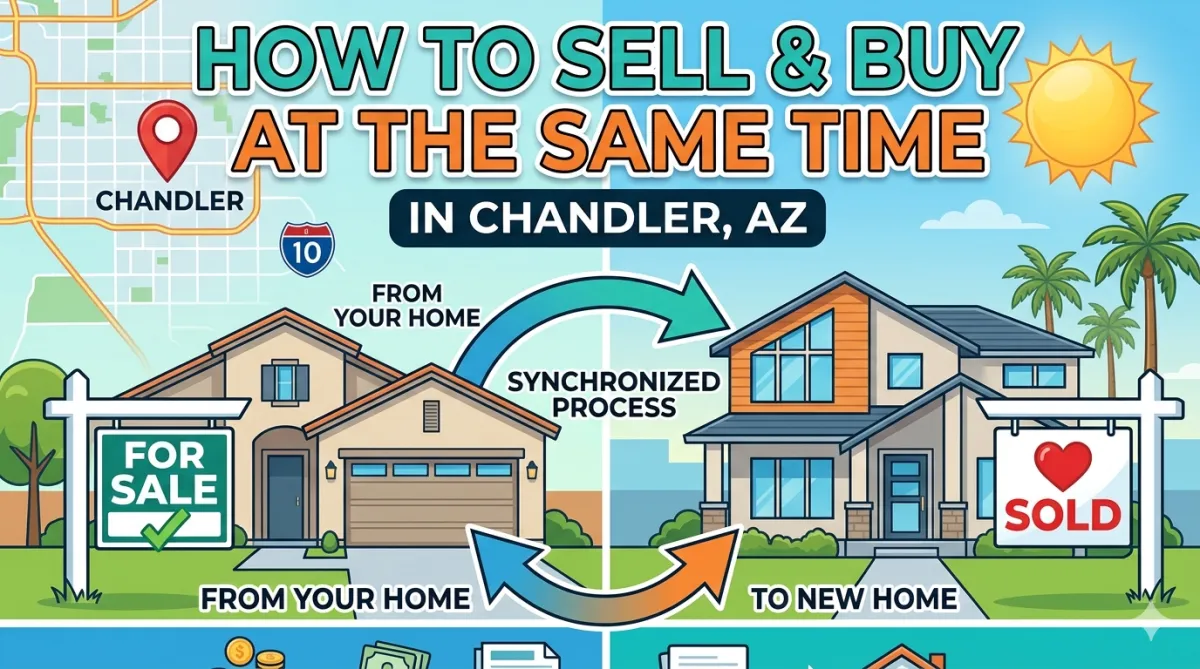
How to Sell & Buy at the Same Time in Chandler?
How to Sell & Buy at the Same Time in Chandler?
First, Let’s Get Honest About the Problem 1
Start Here: Know Your Numbers Before You Do Anything 2
The 3 Real Ways People Do This (And What They Feel Like) 3
3. Do Both at the Same Time (The “Balancing Act”) 3
Let’s Talk About Rent-Backs (This Is a Big One) 4
Timing Matters More Than People Think 5
Pricing Your Home Right Is Non-Negotiable 6
The Buy Side Feels Different When You’re Also Selling 7
What Usually Goes Wrong (So You Can Avoid It) 8
What This Feels Like When It’s Done Right 9
This is one of those situations that sounds simple when you first say it out loud.
“I’ll just sell my house and buy another one.”
Cool. Makes sense.
Then you actually start thinking through the timing, the money, the stress of moving twice, and suddenly it feels like trying to jump from one moving car to another without tripping.
If you’re in Chandler and thinking about doing this, you’re not the only one. This comes up all the time, especially for people moving up, downsizing, or just trying to land in a better area for their day-to-day life.
And the truth is… it can work really well.
But only if you go into it with a plan that actually fits how this market behaves.
So let’s walk through it like we would if we were sitting at a kitchen table figuring this out together.
First, Let’s Get Honest About the Problem
The challenge isn’t buying.
The challenge isn’t selling.
It’s the gap in between.
Because here’s what usually keeps people stuck:
You don’t want to sell first and end up without a place to go.
But you also don’t want to buy first and end up carrying two mortgages longer than expected.
That tension is what makes people freeze.
And if you don’t have a clear strategy, you end up either rushing decisions or delaying everything.
Neither one feels good.
So the whole game here is controlling timing as much as possible.
Not perfectly. Just enough to stay in control.
Start Here: Know Your Numbers Before You Do Anything
Before you look at a single house, before you talk yourself into a dream kitchen or a bigger backyard, you need to know exactly what your current home can realistically sell for in today’s Chandler market.
Not what Zillow says.
Not what your neighbor sold for six months ago.
What it would likely sell for right now, based on current demand, condition, and competition.
Because that number drives everything.
It affects:
your budget for the next home
how much cash you’ll walk away with
whether you can compete on the buy side
how flexible you can be with timing
Once you know that number, things start to feel a lot less fuzzy.
You’re not guessing anymore.
You’re making decisions based on something real.
The 3 Real Ways People Do This (And What They Feel Like)
There’s no one “right” way to sell and buy at the same time.
But there are three paths most people end up choosing from.
Each one has a different level of risk, stress, and flexibility.
1. Sell First, Then Buy
This is the safer move financially.
You list your home, get it under contract, close, and then go shopping for your next place.
Simple, right?
Well… not always.
Because now you have a new problem.
Where do you live in between?
Some people stay with family.
Some people do a short-term rental.
Some people negotiate a rent-back (we’ll talk about that in a second).
The upside here is you know exactly how much money you’re working with when you go buy.
No guessing. No pressure.
The downside is you might feel rushed to find your next place before your move-out date hits.
This works best for people who want certainty with their finances and are okay with a little temporary inconvenience.
2. Buy First, Then Sell
This is the more comfortable move emotionally.
You find your next home, get under contract, move in, and then deal with selling your current home after.
No scrambling. No temporary housing.
Sounds great… until you look at the numbers.
Because now you may be carrying two homes at once.
That means:
two mortgage payments
higher debt on paper
more pressure if your current home doesn’t sell quickly
Some buyers use bridge loans or tap into equity to make this work, but it’s not always the right fit depending on your financial setup.
This path works best for people who have strong financial flexibility and don’t want to feel rushed on the buy side.
3. Do Both at the Same Time (The “Balancing Act”)
This is what most people in Chandler try to do.
And honestly, when it’s handled well, it can feel surprisingly smooth.
Here’s how it usually plays out:
You prepare your home for sale while also starting your home search.
Once you find a home you want, you either:
make your offer contingent on selling your current home
orlist your home immediately and time everything to line up closely
At the same time, you negotiate things like closing dates and possession timing so both transactions move together.
This takes coordination.
It’s not something you want to wing.
But when it works, you avoid temporary housing and reduce the chance of carrying two homes for long.
Let’s Talk About Rent-Backs (This Is a Big One)
This is one of the most helpful tools in this whole process, and a lot of people don’t realize how useful it can be.
A rent-back means you sell your home, but stay in it for a short period after closing, usually paying the new owner a daily rate.
So instead of rushing out the second you close, you get time.
Time to:
find your next home
close on it
move at a normal pace
In Chandler, this is pretty common, especially when the market is active.
Buyers will often agree to it if the rest of your offer looks solid.
And for you, it creates breathing room.
Instead of everything happening at once, you get a short buffer.
Sometimes that’s all you need.
Timing Matters More Than People Think
This is where things either come together… or fall apart.
You don’t need perfect timing.
But you do need intentional timing.
For example:
If your home is priced right and prepared well, it might go under contract quickly.
That’s great, but now the clock starts ticking.
If you haven’t already started looking seriously, you’re suddenly behind.
On the flip side, if you go out shopping aggressively before your home is even close to ready, you might find something you love and not be in a position to compete.
That’s frustrating.
So the goal is overlap.
Not too early. Not too late.
Just enough where:
your home is ready or almost ready to list
you’re actively watching the market
you can move quickly when the right opportunity shows up
This is where having a clear plan makes everything feel less chaotic.
Pricing Your Home Right Is Non-Negotiable
You don’t have room to “test the market” when you’re trying to buy at the same time.
If your home sits, everything gets harder.
Your timeline stretches.
Your stress goes up.
Your buying options shrink.
Pricing correctly from the start does a few things:
It attracts stronger buyers.
It increases the chance of a faster sale.
It gives you more confidence when you go out and make offers.
Overpricing might feel like you’re leaving room to negotiate, but in this situation, it usually just creates delays you can’t afford.
The Buy Side Feels Different When You’re Also Selling
This part catches people off guard.
When you’re only buying, you can take your time.
You can wait for the perfect house.
You can walk away easily.
When you’re selling too, your mindset shifts a little.
You start thinking in terms of timing and opportunity.
You might need to act faster.
You might need to be more flexible.
That doesn’t mean settling.
It just means being clear on what actually matters most to you.
Because if everything is a must-have, you’ll get stuck.
And that’s the last place you want to be when your current home is already in motion.
What Usually Goes Wrong (So You Can Avoid It)
Most issues don’t come from the market.
They come from planning mistakes.
A few common ones:
Trying to do everything last minute
This creates pressure and limits your options.
Not preparing the current home early enough
If your house isn’t ready, your timeline falls apart fast.
Being unclear on budget
This leads to hesitation or overextending.
Waiting for “perfect timing”
That moment doesn’t really show up the way people expect.
The smoother deals are the ones where people got ahead of these things.
Not perfectly.
Just early enough to stay in control.
What This Feels Like When It’s Done Right
It’s not stress-free.
Let’s be real about that.
But it does feel manageable.
You know what’s happening next.
You’re not guessing every step.
There’s a plan, and it adjusts when needed.
You might still have moments where things feel tight or uncertain, but you’re not reacting blindly.
You’re making decisions based on a strategy you already thought through.
That’s the difference.
A Simple Way to Think About It
If you’re trying to sell and buy at the same time in Chandler, think of it like this:
You’re not juggling two separate deals.
You’re managing one connected move.
Every decision on one side affects the other.
So instead of asking:
“When should I sell?”
or
“When should I buy?”
A better question is:
“How do these two timelines work together in a way that keeps me in control?”
That shift alone changes how you approach everything.
Final Thoughts
If you’re thinking about making a move like this, don’t wait until everything feels urgent to start figuring it out.
This is one of those situations where a little planning upfront saves you a lot of stress later.
You don’t need a perfect plan.
You just need a clear one.
Know your numbers.
Understand your options.
Be realistic about timing.
And give yourself enough room to adjust as things move.
Because they will move.
And when they do, you’ll be glad you didn’t try to figure it all out on the fly.
About the Author
Nancy Wittenberg is a Chandler, Arizona real estate agent with Coldwell Banker Realty who helps buyers and homeowners move forward with clarity and confidence. She is the creator of the Buyer Care Plan™, a step-by-step approach designed to guide buyers through the home-buying process with education and support.
Nancy works with both buyers and sellers throughout Chandler and the surrounding East Valley, helping homeowners sell with strategic preparation while guiding buyers through their next move.
Nancy Wittenberg
Realtor®, Coldwell Banker Realty
Chandler, Arizona