What is Your Home
Really Worth?
If you’ve been wondering what your home might sell for in today’s market, a quick online estimate usually doesn’t tell the full story. What really matters is how your home compares to recent local sales, your neighborhood, your condition, and what buyers are actually paying right now. I put together custom home valuation reports to give you a real-world look at your home’s likely value, what could impact that number, and what your next move could look like if you decided to sell. If you want one, just send me your address and I’ll get it started.

How Does The Home Valuation Process Work?
Watch this quick video to see how to get a free home value report!
Meet Nancy
With 16 years of experience and more than 160+ successful transactions, I am a licensed REALTOR® with Coldwell Banker Realty in Mesa, AZ who proudly serves buyers and sellers throughout Chandler, Gilbert, and the Greater Phoenix Metro.
Real estate is one of the most significant decisions you'll ever make, and I don't take that lightly. Whether you're purchasing your first home or selling a property you've poured your heart into, I bring expert guidance, clear communication, and genuine care to every step of the journey.
Recognized as a 2024 Top Customer Service Award winner, my approach is built on trust, transparency, and results.
Selling a home is far more than placing a listing. It requires strategic pricing, compelling marketing, and skilled negotiation. Every property has a unique story worth telling, and I tell it well. Through my M.A.G.N.E.T. targeted marketing strategy, I maximize your home's visibility, attract the right buyers, and work tirelessly to achieve the best possible outcome, from listing day to closing day.
Whether this is your first transaction or your tenth, I am honored to serve as Your Dedicated Home Advocate.
Welcome to your Arizona Community Page!
What People Are Saying
Enjoy the latest & most up-to-date information on the market and how it can affect
your real estate decisions!
Want a Free Custom Home Value Report?
I Might Not Be The Right Agent for You
Trust and communication is crucial when working with hundreds of thousands of dollars, or more!
If we have very different values, processes, and morals I might not be the right agent for you.
Watch this video to better understand who I am to decide if I'm right for you.
Will Your Home Sell Quickly?
Selling expectations are a common question my clients and I have.
Even though you will be asking me that question, the answer begins with you.
Which of the M.A.G.N.E.T. marketing strategies will you choose?
Watch for More Details.
Curb Appeal Matters!
Photos can accomplish a LOT, but they are not miracle workers.
Your house has maybe 2 seconds to catch someone's attention before they scroll on past online.
Every moment matters and that takes careful planning!
Would You Stop to Look at Your House?

Request your FREE copy of Selling Secrets: Insider Strategies for Selling Your Home Quickly & For Top Dollar in Arizona!
Get your FREE copy of Buying Secrets, Insider Strategies for Buying your First, Next, or Forever Home.
The Best Sugar Cookies in Arizona
My Favorite Pizza in
Arizona
The Best Things to Do
Arizona
Our Go-To Park -
in Arizona
Communities across Arizona are served by highly regarded local school districts, helping support strong neighborhoods and home values.
Here’s a glimpse of some of the many schools Arizona has to offer its residents.
To learn more about these schools, click the button below!
Why Work With Me?
We know the Arizona real estate market like the back of our hand!
While we proudly serve clients across Arizona, we also assist buyers and sellers in surrounding communities throughout the region.
It’s this local insight and experience that can make all the difference—whether that means getting top dollar for your home or leaving money on the table, overpaying or securing a great deal, finding the perfect property or missing out, and navigating inspections with confidence instead of uncovering costly surprises later.
Nancy Wittenberg is a full-service Realtor®, aligned with a professional team and trusted network of partners, handling every step of the process for you—from pre-market preparation and staging, to modern digital marketing and proven traditional strategies, to contracts, disclosures, and skilled negotiation on your behalf. She’ll guide you through the entire transaction from start to finish, making the experience as smooth as possible.
Her passion is PEOPLE—helping others through education, guidance, and honest advice. Nancy is committed to putting people first, always.
If you’d like to talk real estate—or simply connect over coffee—reach out anytime. She’d love to meet you!
What my customers say

"Nancy Wittenberg has helped us and worked with us every step of the way. We are so appreciative of all you have done, going on and above for all of us. You are a God sent, and we can’t thank you enough! I pray that you are able to help other buyers or sellers as you helped us. Thank you from the bottom of our hearts."
- Sylvia and Raul R
"Nancy was so extremely helpful, trustworthy, responsive, upfront, and honest! As a first time home buyer the process was a bit intimidating but Nancy put all of our worries to ease. We will absolutely be using Nancy again for our future home purchases! You are the best, thank you!!"
- Michaela M.
"Nancy recently helped me buy a home in Mesa, AZ. She has a good eye for catching things that a buyer might not notice. Her skill and experience at negotiation can make a deal that might otherwise be out of reach. Nancy goes the extra mile, getting answers to complicated questions and making sure that both sides feel good about a transaction. "
-Nick C.
PRIVACY POLICY
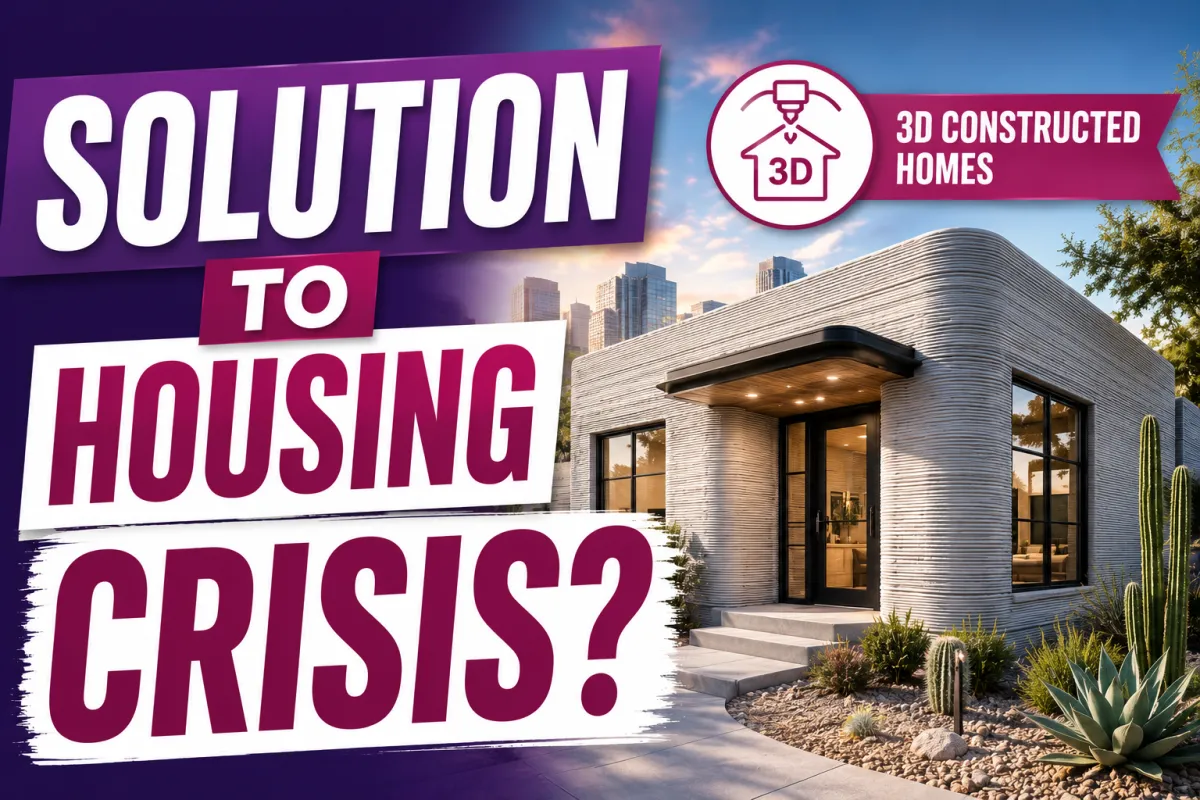
What Arizona's Construction Labor Shortage Means for Home Buyers in the Southeast Valley
What Arizona's Construction Labor Shortage Means for Home Buyers in the Southeast Valley
Building a Home Requires More Trades Than Most Buyers Realize 1
How Serious Is the Shortage? 2
Why the Labor Force Never Fully Recovered After 2008 3
Technology Is Starting to Enter the Picture 4
What 3D Printed Homes Actually Are 5
The Workforce Has to Come With the Technology 6
What This Means If You're Buying in the Southeast Valley Now 7
Every conversation about home prices in the Southeast Valley comes back to the same problem: there aren't enough homes.
The gap between supply and demand has shaped this market for years. Prices climbed fast. Competition stayed strong. Buyers who were ready financially still faced a short list of available properties and the kind of pressure that came with multiple offers and fast-moving timelines.
So why aren't builders just building more?
They want to. The bigger obstacle isn't land or materials. It's people. Arizona has a real and growing shortage of skilled construction workers, and that shortage is one of the main reasons new home supply hasn't caught up to the population that keeps arriving here.
Understanding what's behind this shortage, and what's being done about it, helps buyers make better decisions today and set realistic expectations for what comes next.
Building a Home Requires More Trades Than Most Buyers Realize
A home doesn't go up in one continuous sequence. It's a relay race involving more than a dozen trades, each with its own window in the schedule.
Land gets cleared and graded. Foundations get poured and cured. Framers can't start until the foundation is solid. After framing, rough electrical and plumbing go in before walls close up. Then insulation, drywall, and finish work. HVAC. Cabinets. Flooring. Each trade depends on the one before it.
A delay in any one of those trades delays every trade that follows. When those workers are hard to find and hard to schedule, projects take longer. And longer projects cost more, because builders are paying interest on their construction financing the entire time the home sits unfinished.
Buyers see the result on the price tag. But the cause is a shortage that starts months before the first shovel hits the ground.
How Serious Is the Shortage?
Industry estimates put the number of new construction workers needed in the U.S. at approximately 439,000 in 2025. Demand is expected to climb in 2026 as building activity increases in growth markets like the Phoenix area.
The shortage touches nearly every skilled trade. Framers. Electricians. Plumbers. Concrete workers. HVAC technicians. Finish carpenters. When any of those specialties gets stretched thin, it creates a bottleneck that can't be worked around.
For buyers, this isn't an abstract economic problem. It shows up in longer construction timelines, higher costs on new builds, and a resale market where there still aren't enough homes to match what buyers need.
Why the Labor Force Never Fully Recovered After 2008
The 2008 housing crisis didn't just slow construction. It collapsed it.
When the market fell apart, builders stopped building. Skilled tradespeople who had spent careers in construction were suddenly out of work. A significant portion of them didn't come back. Some retired. Others moved into different industries. Young people who might have entered the trades watched the industry contract and made different choices.
When the housing market eventually recovered, the workforce didn't come back at the same speed. Apprenticeship programs and trade schools were producing new workers, but training takes years and the pipeline had a delay built into it. The industry has been trying to close that gap ever since.
In Arizona specifically, population growth accelerated the problem. The Phoenix area kept growing through and after the recovery. Builders needed workers to meet rising demand, but the labor market for skilled trades was already stretched. Builders here compete for workers with construction projects across the entire Sun Belt, and wages have had to go up to attract them.
Higher wages are good for workers. They add directly to the cost of every home being built.
Technology Is Starting to Enter the Picture
The labor shortage isn't going unaddressed. Construction companies and researchers have been working on technologies designed to reduce the number of workers needed for certain phases of a build, speed up the process, and lower overall costs.
In April 2026, Rio Salado College in Tempe hosted a public panel called "Innovating the Future of Affordable Housing." The event brought together Tempe Mayor Corey Woods, the founder of construction technology company Alquist 3D, and leaders from Sundt Construction, one of the largest construction companies in the country. The panel focused on how new building technologies and workforce training programs can work together to address Arizona's housing challenges.
One of the technologies getting the most attention right now is 3D-printed construction.
What 3D Printed Homes Actually Are
Most people picture something small and plastic when they hear "3D printing." Construction-scale 3D printing is something different entirely.
It uses a specialized concrete mix, extruded through a large printer head that moves along a track, depositing material layer by layer to form walls. The printer builds the structural shell of a home from the ground up. It doesn't replace the foundation or the roof or the interior systems. But it can complete the wall phase faster than traditional framing under the right conditions.
The concrete itself has to meet specific requirements. It needs to be fluid enough to pump through the system and hold shape precisely as it's laid. It has to cure fast enough that the next layer can be added without the previous one slumping. And it needs to be strong enough to meet building code requirements for the finished structure.
Arizona's desert heat creates its own challenges. Concrete that performs well in moderate climates behaves differently when ambient temperatures regularly exceed 100 degrees. The curing process is affected by heat. Alquist 3D has been working with universities, local governments, and private partners to develop concrete formulations designed specifically for conditions like Arizona's.
The potential benefits are real. Printing a home's walls is faster than traditional framing when everything is working as intended. Fewer workers are needed on-site during that phase. Some of the most labor-intensive parts of the structural process can be handled with a smaller crew.
But 3D printing doesn't replace the whole workforce. The foundation still requires traditional preparation. After the shell goes up, electricians, plumbers, HVAC technicians, and finish workers are still needed. The technology shortens one part of the timeline. Not all of it.
The Workforce Has to Come With the Technology
New technology only helps if there are trained people to run it.
Operators who know how to calibrate the concrete mix for local temperature conditions, maintain the printing equipment, and integrate the process with traditional trades don't exist in large numbers yet. That workforce has to be built from the ground up. It's one of the reasons Rio Salado College has been developing curriculum around emerging construction technologies through its Applied Tech and Engineering programs.
Sundt Construction, also represented at the April panel, has been investing in both new technology adoption and workforce development across its operations. Companies at that scale see training and innovation as connected, not separate. You can't adopt new methods at scale without workers who understand them.
The goal is a pipeline: train workers on both traditional building methods and the newer approaches companies are deploying, so the construction industry has the capacity to build more homes faster and at lower cost.
That pipeline takes time to fill. Training programs take years to develop and years to produce graduates in meaningful numbers. The improvements won't show up overnight in what buyers see available to purchase.
What This Means If You're Buying in the Southeast Valley Now
Most industry leaders who've discussed this have been honest about the timeline. Relief from the labor shortage, and meaningful adoption of new construction technologies, will take years to show up in regional housing supply in a way that moves prices.
Buyers making decisions in 2026 need to work within the market that exists now, not the one that might exist in five or ten years. Interest rates and monthly payment math are still the central variables in what a buyer can actually afford right now. Future improvements in construction efficiency won't change what the numbers look like on a loan application this month.
The good news is the current market has shifted in buyers' favor compared to 2021 and 2022. There's more inventory. Less competition. Sellers are more willing to negotiate on price and on closing cost contributions. That shift has been documented across the Phoenix metro area and it reflects a real change in the balance between buyers and sellers.
New construction inventory exists in parts of the Southeast Valley at price points buyers can reach. Understanding what new builds look like compared to resale options at similar price points is worth doing if you're doing serious research. The two categories come with different tradeoffs.
The supply constraint is real. It's not going away quickly. But for buyers who are financially ready and have found the right property, the current environment offers more room to make a thoughtful decision than this market has allowed in years.
Frequently Asked Questions
Why are homes in the Southeast Valley still expensive even when mortgage rates have come down from their 2023 peaks?
Prices in this market are driven largely by the gap between supply and demand, not interest rates alone. The construction labor shortage has limited how many new homes can be built. Population growth has continued. There simply aren't enough homes to match what buyers need, and that keeps prices from falling significantly even as rates ease.
What is 3D printed home construction and when will it be widely available in Arizona?
3D printed construction uses a large printer to extrude specialized concrete layer by layer to form a home's walls. It can reduce the labor needed for the structural phase and speed up that portion of the build. Companies including Alquist 3D are working with Arizona partners on concrete formulations suited to desert heat. The technology is promising but not yet deployed at a scale that would meaningfully affect regional housing supply in the short term. Wide adoption is still several years away.
How does the construction worker shortage affect what buyers pay for a home?
When skilled tradespeople are hard to find, wages go up. Builders pass those higher labor costs through to the sale price. Projects also take longer to complete when key trades are stretched thin, which increases the cost of the construction financing the builder carries during that time. Both of those factors add to the price of the finished home.
Is now a good time to buy in the Southeast Valley given the supply issues?
The supply issue is real but it's not the only factor. Current conditions give buyers more room than they've had in recent years. More inventory, less competition, and more willingness from sellers to negotiate are all working in buyers' favor right now. The supply constraint hasn't disappeared, but buyers who are financially ready and have found the right property have reasonable grounds to move forward.
What should first-time buyers understand about the Southeast Valley housing market in 2026?
The most important preparation is financial. First-time buyers often underestimate how much their debt-to-income ratio and credit profile shape what they can buy and where. The market is more approachable right now than it's been in several years, but well-priced homes in good condition can still move quickly. Being pre-approved and financially ready is what gives buyers the ability to act when the right property shows up.
Will 3D printed homes eventually be cheaper than traditionally built homes in Arizona?
The long-term potential is that faster builds and lower labor costs during the structural phase could reduce the final sale price. That math doesn't fully work yet at scale. Development costs for climate-specific concrete mixes, equipment, training, and the remaining trades that 3D printing doesn't replace still add up significantly. The technology might bring costs down over time. For buyers shopping today, it isn't a factor in the price of what's currently available.
Sources: Rio Salado College, "Building the Future: Rio Salado Panel to Explore Housing Innovation," April 2026; U.S. construction workforce estimates, industry projections 2025-2026; National Association of REALTORS 2025 housing supply data.
Published July 2026 | Home Buying | Southeast Valley, Arizona





Search
CITIES
Resources
ABOUT
© Copyright 2026. Nancy Wittenberg. All Rights Reserved.